Becoming a Sought-After Change Management Consultant
 ACTSol and Associates
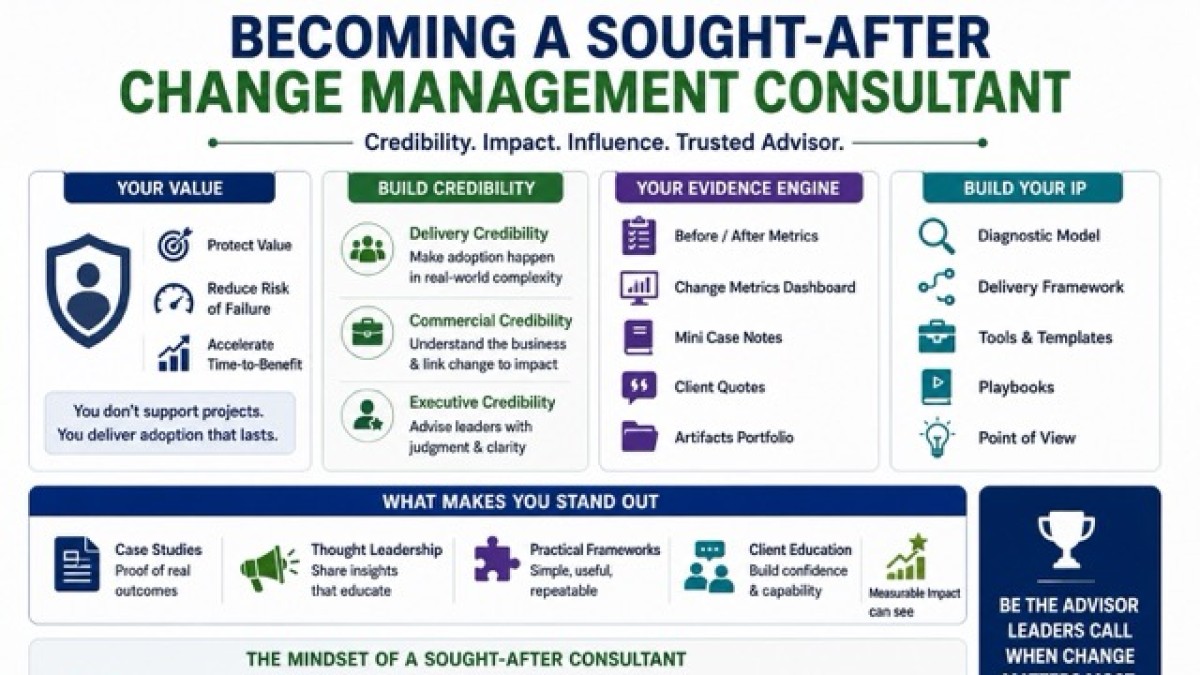
Build credibility, IP, and delivery that make change stick—so clients seek you out.

Most people say they want change. What they actually want is: results without disruption, speed without confusion, and adoption without arguments. That gap is your opportunity.
A sought-after change management consultant isn't the person who runs town halls, sends newsletters, and counts "training completion." They're the person leaders call when a transformation is at risk; because they know how to turn strategy into behaviour, intent into routines, and "go-live" into real usage.
This article shows how to become that person by deliberately building credibility, developing IP (intellectual property), and creating a personal brand that signals trust and outcomes. And it covers the differentiators that separate average practitioners from high-demand consultants: case studies, thought leadership, frameworks, and client education.
The uncomfortable truth about the change market.
Here's what the market rewards (and what it quietly ignores): The market rewards outcomes. Adoption, utilisation, compliance, productivity, customer impact, risk reduction.
The market ignores activity.
Number of emails sent, posters printed, workshops conducted, "stakeholders engaged."
If you want to be sought-after, stop selling "change management." Start selling reliable adoption in messy environments.
That means your positioning needs to be clear:
- a) You don't "support" projects. •You protect value.
- b) You reduce the probability of expensive failure.
- c) You accelerate time-to-benefit.
When you speak that language, senior leaders listen.
1) Build credibility like a consultant, not like a coordinator.
Credibility isn't a badge. It's an accumulation of proof; built across three dimensions.
A. Delivery credibility: "Can you make adoption happen?"
You build this by showing you can handle the real friction points:
- a) Resistance that has logic behind it
- b) Middle managers caught between targets and change
- c) Process ambiguity, role confusion, broken data
- d) Tool fatigue ("another system")
- e) Incentives that reward old behaviour
Example: A CRM rollout fails not because the tool is bad, but because sales reps lose time, managers still ask for Excel trackers, and pipeline definitions differ by region. A credible change consultant spots this early, runs a rapid alignment workshop, fixes definitions, updates manager routines, and redesigns the "weekly pipeline review" so CRM becomes the path of least resistance.
B. Commercial credibility: "Do you understand the business?" You gain trust when you talk like an operator:
- a) How revenue is recognised
- b) Where cycle time hides
- c) Why compliance matters
- d) What delays cost
- e) What productivity looks like in that context
Practice: learn to convert change activity into business impact:
- a) Adoption → utilisation → capability → performance metric
- b) Training completion → competence → error reduction
- c) Communications → clarity → decision speed
C. Executive credibility: "Can you advise the sponsor?". Sponsors don't need cheerleading. They need judgement.
Sought-after consultants can tell a sponsor:
- a) What not to do
- b) Where the organisation will break
- c) Which trade-offs are unavoidable
- d) What to say when the room turns hostile
- e) How to show visible commitment without micromanaging
Example: During a merger integration, employees ask: "Will there be layoffs?" A weak approach hides behind comms scripts. A strong approach prepares leaders with a truth-based narrative, clear decision timelines, and manager toolkits that prevent gossip from becoming the operating system.
2) Build an "evidence engine" that makes you hard to ignore.
High-demand consultants don't just do good work. They capture it.
Create a personal system that produces proof continuously:
Your evidence engine should include:
- a) Before / After snapshots: baseline adoption, baseline cycle times, baseline error rates
- b) Change metrics dashboard: usage analytics, compliance checkpoints, sentiment and barriers
- c) Mini case notes: problem → intervention → outcome → lesson
- d) Client quotes: specific statements (not generic praise)
- e) Artifacts portfolio: canvases, toolkits, templates, playbooks (with sensitive info removed)
Example artifact titles that signal maturity:
- a) "Role Impact Heatmap – Function x Role x Process"
- b) "Manager Enablement Kit – Week 1 / Week 4 / Week 12 routines"
- c) "Adoption Risk Register – Behavioural + Operational risks"
- d) "Resistance Map – Themes, root causes, and negotiation points"
- e) "Sustainment Plan – Governance and reinforcement schedule"
When you can show your work, you stop sounding like theory.
3) Build IP: your frameworks are your unfair advantage.
The fastest way to become sought-after is to stop reinventing your approach for every client. Build IP that is repeatable and teachable.
What counts as IP in change consulting?
- a) A diagnostic model (how you assess readiness and risk)
- b) A delivery framework (how you run change from discovery to sustain)
- c) A set of templates (usable by clients)
- d) Measurement approach (how you instrument adoption)
- e) "Language" (terms, categories, patterns that clients adopt)
Your IP is not meant to impress other consultants. It's meant to make clients say: "This is structured. This will work here."
A practical IP example: The "CHANGE Value Chain" Use a simple logic chain that clients understand:
Message → Meaning → Motivation → Mechanics → Mastery → Metrics
- a) Message: what we communicate
- b) Meaning: what people think it means for them
- c) Motivation: why they should care now
- d) Mechanics: what they must do differently
- e) Mastery: whether they can do it confidently
- f) Metrics: proof it's happening
This helps you diagnose where adoption is failing:
- a) If there's noise, you have a Message / Meaning problem
- b) If people agree but don't act, you have a Motivation problem
- c) If they try but struggle, you have a Mechanics / Mastery problem
- d) If leaders argue about progress, you have a Metrics problem
Now you sound like someone with a method; not someone with activities.
Rules for building strong change IP
Your framework must be:
- a) Simple enough to remember
- b) Specific enough to drive actions
- c) Measurable enough to prove progress
- d) Modular enough to fit different contexts
- e) Teachable to managers and project teams
If it can't be used by a client when you're not in the room, it's not IP. It's a slide.
4) Case studies: the currency of trust.
Case studies are not marketing fluff. They are decision shortcuts for buyers.
A strong case study answers:
- What was at stake?
- What got in the way?
- What did we do differently?
- What changed (measurably)?
- What would we repeat next time?
Case Study 1: ERP rollout that was "on time" but failing Context: A mid-size manufacturing firm went live on ERP. Transactions were happening but outside the system too. Excel shadow processes flourished.
Hidden problem: Managers were still measuring performance using the old reports. People did what got rewarded.
Interventions:
- a) Redesigned operational routines (daily production review, GRN checks, dispatch planning) inside ERP reports
- b) Introduced role-based "critical transactions" list (5 per role, non-negotiable)
- c) Created a 2-week hypercare cadence with issue triage + learning loops
- d) Aligned KPIs to system usage (not just output)
Outcome: Reduction in manual trackers, improved data accuracy, faster month-end closure, fewer rework loops.
Why this is compelling: It shows you understand that adoption is behavioural + managerial, not just training.
Case Study 2: Digital sales transformation with frontline resistance
Context: New sales enablement tools were introduced. Sales teams resisted, citing "admin burden."
Root cause: The CRM workflow added steps without removing old steps. Plus, the lead quality process wasn't fixed.
Interventions:
- a) Simplified data capture to "minimum viable fields"
- b) Sutomated lead assignment rules
- c) Retrained managers to coach from CRM dashboards
- d) Created a recognition system for clean pipeline hygiene
Outcome: Higher CRM usage, improved forecasting reliability, faster follow-ups, reduced internal friction.
Why this is compelling: It demonstrates pragmatic design reducing friction, not preaching compliance
5) Thought leadership: stop posting opinions, start publishing assets.
Thought leadership that works is not motivational content. It is usable thinking.
A simple thought leadership loop:
- Observe a repeating pattern in clients
- Name the pattern (make it memorable)
- Model it (a framework or checklist)
- Prove it (a story, data point, mini case)
- Package it (PDF, canvas, toolkit, workshop)
- it (client sessions, webinars, internal enablement)
Example: Turn a common issue into a signature idea
Observation: "Managers are the bottleneck in adoption."
Name it: The Manager Multiplication Effect
Model it: A 4-routine system:
- a) Weekly team huddle (what's changing)
- b) Coaching (how to do it)
- c) Review (did we do it)
- d) Reinforcement (what gets recognised)
Prove it: Case story from ERP / CRM
Package it: "Manager Enablement Kit"
Teach it: 60-minute manager clinic
Now your personal brand becomes associated with a specific solution.
6) Client education: the most underrated differentiator
Here's what top consultants understand: When clients don't value change, it's often because they don't understand how it creates ROI. So, you educate; not by lecturing, but by reframing.
What client education looks like in practice
- a) Sponsor briefings: "What you must do in the next 30 days"
- b) Manager clinics: "Your new routines, simplified"
- c) Team enablement: "How this makes your day easier"
- d) Project team playbooks: "How change integrates with delivery"
- e) Myth-busting sessions: "Why training alone doesn't work"
A powerful education tool: the "Cost of Non-Adoption" conversation
Instead of saying "we need comms and training," quantify what non-adoption costs:
- a) Delays in benefits realisation
- b) Rework and manual workarounds
- c) Data quality issues
- d) Compliance exposures
- e) Customer experience breakdowns
- f) Employee frustration and turnover
Example: If a procurement process isn't adopted, savings leakage continues. If an incident reporting process isn't adopted, safety risks compound. If CRM isn't adopted, forecasting becomes politics.
Educate clients to see change as a value-protection discipline.
7) Your consulting operating model:
Top change consultants run with precision. They don't "support the project." They run a parallel adoption system.
A robust engagement flow (simple, repeatable)
- Discovery and impact mapping (process, role, policy, system, behaviour)
- Readiness and risk diagnosis (barriers, capability gaps, sponsor alignment)
- Adoption strategy and roadmap (waves, pilots, reinforcement)
- Enablement and comms (segmented, role-based)
- Manager mobilisation (routines + coaching)
- Instrumentation (dashboards, usage analytics, feedback loops)
- Sustainment (governance, ownership transfer, audits)
The difference is not the steps. The difference is the quality of execution:
- a) Sharp segmentation
- b) Realistic resistance handling
- c) Friction removal
- d) Metrics that matter
- e) Leadership routines that stick
8) Personal brand: build signal, not noise.
A strong personal brand is not "being visible." It's being recognisable for a specific kind of outcome.
Build your brand around:
- a) A point of view (what you believe about change)
- b) A niche (industry, function, transformation type)
- c) A signature framework (your IP)
- d) Proof (case studies, client results)
- e) Assets (templates, toolkits, guides)
- f) A teaching voice (how you educate)
Practical brand assets to create
- a) "Change Adoption Playbook" (10–15 pages)
- b) "Readiness Diagnostic" (scored)
- c) "Stakeholder Influence Map Template"
- d) "Manager Enablement Toolkit"
- e) "Adoption Metrics Dashboard Outline"
- f) "Hypercare Operating Rhythm" guide
- g) One strong flagship case study
These assets make clients feel: "This person has done this before."
9) Frameworks, case studies, thought leadership, client education: how they work together
These four elements are not separate. They form a flywheel:
- a) Frameworks make your work repeatable
- b) Case studies prove your frameworks work
- c) Thought leadership distributes your ideas
- d) Client education increases willingness to invest
- e) Which gives you better engagements, producing better proof fuel for the next cycle
This is how you become sought-after: not by being everywhere, but by being the obvious choice for a certain type of change problem.
Days 1–30: Build your foundation
- a) Choose a niche: (e.g., ERP adoption, operating model changes, post-merger integration, frontline transformation)
- b) Create your core framework (one page, memorable)
- c) Build 3 templates that support it
- d) Write one strong case study (even if anonymised)
Days 31–60: Build assets and proof
- a) Run two "client education" sessions (internal or external)
- b) Publish 6 thought leadership posts that teach (not motivate)
- c) Create one downloadable guide
- D) Build a simple adoption metrics model you can reuse
Days 61–90: Build visibility and demand
- a) Host one workshop / webinar: "Preventing Adoption Failure in Digital Transformations"
- b) Publish your flagship case study
- c) Reach out to 20 targeted buyers with a specific offer: diagnostic + roadmap
- d) Package your services into 2–3 clear offerings (diagnostic, delivery support, sustainment)
Consistency beats intensity. Do the basics well, repeatedly.
The closing insight: become the consultant who makes change usable
Change fails when it stays abstract. It succeeds when it becomes usable.
Usable means:
- a) Clear roles
- b) Simple routines
- c) Friction removed
- d) Managers aligned
- e) Measurement in place
- f) Reinforcement built into operations
If you can repeatedly deliver that; while capturing proof, building IP, and teaching clients you won't have to chase work.
You will become the person organisations call when the stakes are real and the timeline is tight.
Not because you "do change management." But because you make change stick.
Categories: : Management