Change Fatigue vs. Process Discipline
 ACTSol and Associates
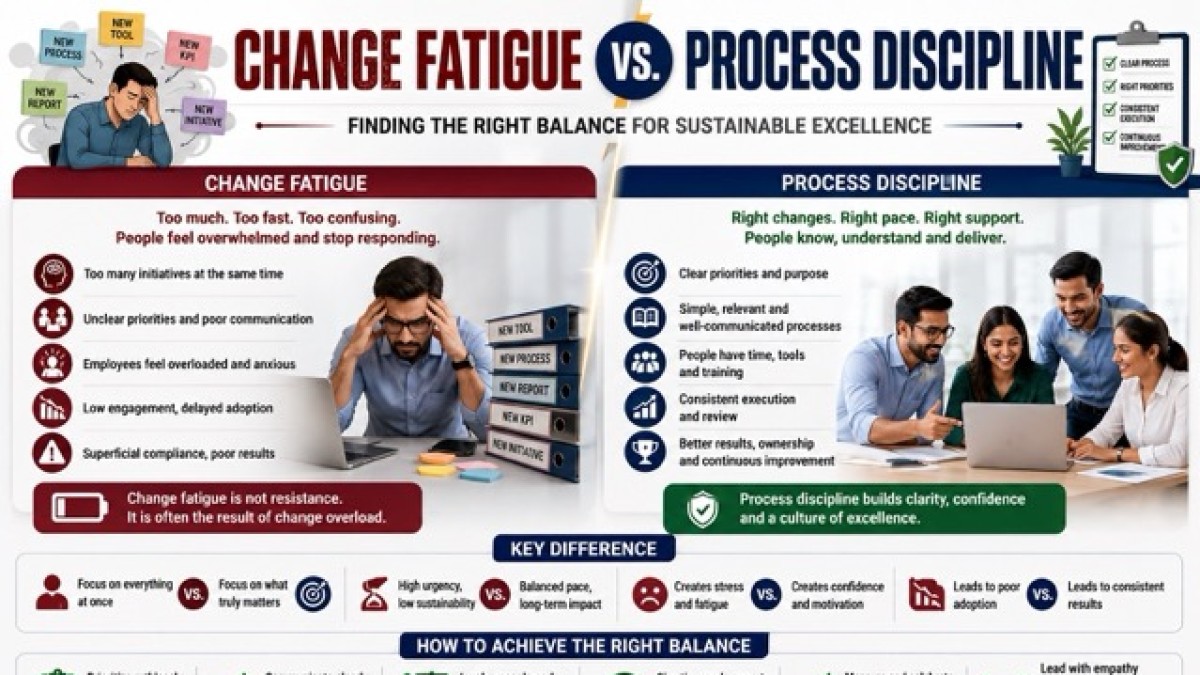
Build process discipline without change fatigue through prioritization, pacing, and clear support.

In the journey of process excellence and change management, organizations often face a difficult question: How much discipline is necessary, and when does discipline become pressure? This topic fits naturally within the people-centered transformation theme, where human behavior, leadership, and emotional engagement are central to successful change.
Every organization needs discipline. Without process discipline, work becomes inconsistent, errors increase, accountability weakens, and performance becomes dependent on individuals rather than systems. However, when every week brings a new initiative, every meeting introduces another priority, and every employee is expected to adopt multiple changes without time, clarity, or support, discipline can turn into exhaustion. This is where change fatigue begins.
Change fatigue is not laziness. It is not always resistance. It is often the result of too many changes, poorly sequenced initiatives, unclear priorities, weak communication, and unrealistic expectations. People may stop responding not because they do not care, but because they are overwhelmed. On the other hand, process discipline is not rigidity. Healthy discipline creates clarity, consistency, ownership, and reliability. It helps people know what to do, how to do it, when to do it, and why it matters.
The real challenge for leaders is to build discipline without creating fatigue.
Understanding Process Discipline
Process discipline means following agreed ways of working consistently. It includes using SOPs, checklists, workflows, approval matrices, reporting formats, review mechanisms, and performance indicators in daily operations. It is the foundation of reliability.
In a disciplined organization, people do not depend only on memory, personal style, or informal instructions. They follow defined processes. They know their roles. They understand escalation points. They maintain records. They review deviations. They correct gaps. They improve processes based on facts.
Healthy process discipline brings many benefits. It reduces confusion, improves quality, minimizes rework, supports training, strengthens accountability, and enables scalability. For a growing organization, process discipline is especially important because informal working methods that function with 10 people may fail when the organization grows to 100 or 500 people.
However, process discipline must be practical. If SOPs are too complex, approvals are excessive, reports are duplicated, and controls are not linked to real risks, people will treat discipline as bureaucracy. They may comply only when being watched. This creates superficial compliance, not true adoption.
The purpose of process discipline is not to make people blindly follow documents. The purpose is to make work predictable, controlled, and improvable.
Understanding Change Fatigue
Change fatigue occurs when people feel emotionally, mentally, or operationally overloaded by continuous change. It is the feeling of “again something new,” “this will also not last,” or “we are already busy, why another initiative?”
Employees may experience change fatigue when too many transformation projects are launched at the same time. They may be asked to implement new software, follow new SOPs, attend training, change reporting formats, adopt new KPIs, participate in audits, and improve productivity—all while continuing daily work. If leadership does not prioritize properly, employees start seeing change as disturbance rather than improvement.
Change fatigue may show up in several ways. People may attend training but not apply learning. They may sign SOP acknowledgment sheets but continue old practices. They may delay implementation. They may become silent in meetings. They may say yes in front of seniors but ignore the change later. Middle managers may become defensive because they are expected to deliver both routine results and transformation results without additional support.
In many organizations, what is called resistance is actually fatigue. People are not always against improvement. They are against poorly managed improvement.
Healthy discipline gives people stability. Excessive change pressure creates anxiety.
Healthy discipline says, “This is the agreed process, and we will support you in following it.” Excessive pressure says, “Everything must change immediately, and failure will be blamed on you.”
Healthy discipline is built through clarity, training, coaching, review, and correction. Excessive pressure is built through urgency, escalation, repeated instructions, and fear.
Healthy discipline respects operational reality. It asks whether people have the time, skills, tools, authority, and resources to follow the process. Excessive change pressure assumes that issuing instructions is equal to implementation.
Healthy discipline is selective. It focuses on critical processes, high-risk areas, customer impact, compliance needs, and performance priorities. Excessive pressure treats every change as equally urgent.
Healthy discipline creates confidence. Excessive pressure creates fatigue.
For example, implementing a purchase approval SOP is healthy discipline when it clarifies approval limits, reduces unauthorized purchases, and helps vendors get paid on time. But if the same organization simultaneously changes the procurement system, modifies vendor registration rules, introduces five new reporting formats, changes the budget approval process, and starts weekly audit reviews without coordination, the procurement team may feel overloaded. The problem is not the SOP. The problem is the unmanaged change load.
The Role of Overload
Overload is one of the biggest causes of change fatigue. It happens when the volume of change exceeds the organization’s capacity to absorb it.
Every process change requires attention. People must understand it, accept it, learn it, practice it, and adjust their habits. Even a simple change consumes energy. When multiple changes arrive together, employees start prioritizing daily emergencies over new initiatives.
Leaders often underestimate this effort. From the management side, a new process may look simple: issue SOP, conduct training, start implementation. But from the employee side, the change may involve learning new steps, changing coordination with other departments, maintaining new records, handling additional approvals, and explaining delays to customers or internal users.
This is why change load must be managed. Organizations must ask: How many changes are currently active? Which teams are affected? Are the same people involved in multiple initiatives? What is the realistic implementation timeline? What can be paused, merged, or simplified?
Without such questions, even good changes compete with each other and fail.
Poor Prioritization Creates Confusion
Poor prioritization is another major reason for fatigue. When everything is urgent, nothing is truly important.
Many organizations launch multiple improvement initiatives because each one looks valuable. There may be a quality improvement project, cost reduction drive, digital transformation project, SOP implementation program, audit closure plan, customer complaint reduction initiative, and employee productivity campaign. Individually, all may be useful. Collectively, they may create confusion.
Employees need to know what matters most now. They need sequencing. They need clear expectations. They need to understand which process changes are mandatory, which are improvement-oriented, and which are optional or phased.
Poor prioritization also damages credibility. If management announces a new initiative every month but does not complete earlier initiatives, employees learn to wait. They assume the new change will also fade away. This creates passive resistance.
Good prioritization requires leadership discipline. Leaders must resist the temptation to launch too many things. They must define a few critical priorities and stay focused long enough for adoption to happen. Change should not be measured by the number of initiatives started. It should be measured by the number of improvements sustained.
Resistance Is Often a Signal
Resistance is commonly misunderstood. Leaders may see resistance as negativity, but resistance can be useful information. It may indicate unclear expectations, impractical process design, lack of skills, fear of accountability, poor communication, or previous failed experiences.
When employees resist a new process, leaders should not immediately assume bad attitude. They should ask: Is the process practical? Has the team been trained? Are roles clear? Is there duplication? Are there conflicting instructions? Are supervisors aligned? Are tools available? Are people afraid that the new process will expose past gaps?
Resistance often comes from experience. Employees know where processes fail in real life. They know which approvals delay work, which reports are never reviewed, which systems are slow, and which controls create extra work without value. If leaders listen carefully, resistance can become a source of process improvement.
However, listening does not mean abandoning discipline. It means improving implementation. A good leader distinguishes between valid concerns and avoidance behavior. Valid concerns must be addressed. Avoidance must be coached and corrected.
Communication Gaps Increase Fatigue
Communication is one of the most underestimated elements of sustainable implementation. Many change initiatives fail because people are told what is changing, but not why it is changing.
Employees need more than instructions. They need context. They need to know the business reason, customer impact, risk impact, and personal relevance of the change. If a new SOP is introduced, people should understand the problem it solves. Was there rework? Was there a customer complaint? Was there audit non-compliance? Was there financial leakage? Was there dependency on one person? Was there delay in decision-making?
Communication must also be repeated. One email or one training session is not enough. People absorb change gradually. They need reminders, examples, FAQs, manager discussions, visual aids, and practical demonstrations.
Communication gaps also occur when top management, middle management, and frontline teams communicate different messages. Senior leaders may say the change is critical, but middle managers may treat it as additional paperwork. Employees then follow the behavior of their immediate managers, not the words of senior leadership.
Therefore, change communication must be aligned across levels. Leaders must speak consistently. Managers must reinforce the same message. Supervisors must help teams apply the process in daily work.
Sustainable Implementation: The Middle Path
Sustainable implementation is the balance between discipline and human capacity. It means changes are introduced in a way that people can understand, adopt, practice, and sustain.
- The first step is to reduce unnecessary complexity. Every SOP, checklist, report, and approval should serve a purpose. If a control does not reduce risk, improve quality, support compliance, or enable decision-making, it should be questioned. Process discipline should be lean, not heavy.
- The second step is to phase implementation. Not all processes need to go live at once. Critical processes can be prioritized first. Supporting processes can follow. Teams should be given time to stabilize one change before another is imposed.
- The third step is to involve users in process design. People who perform the work should help validate the process. This increases practicality and ownership. A process designed only in a meeting room may look perfect on paper but fail in operation.
- The fourth step is to support managers. Middle managers are the bridge between strategy and execution. They carry the pressure of implementation. If they are not trained, aligned, and supported, change fatigue spreads quickly.
- The fifth step is to review adoption, not just completion. Implementation should not end when SOPs are issued or training is completed. Leaders must check whether people are actually following the process. Are records maintained? Are deviations reported? Are approvals happening correctly? Are KPIs improving? Are employees facing practical difficulties?
- The sixth step is to reinforce progress. Recognition matters. Teams that adopt disciplined working should be appreciated. Small wins should be shared. Improvement should feel meaningful, not only mandatory.
Practical Leadership Actions
Leaders can prevent change fatigue by managing the pace and quality of change.
They should maintain a change calendar showing major initiatives, affected teams, timelines, and expected effort. This helps avoid overload. They should classify initiatives as critical, important, or optional. They should remove duplicate reporting and unnecessary meetings. They should ensure that every new process has an owner, training plan, communication plan, and review mechanism.
Leaders should also ask teams what can stop. Sustainable change is not only about adding new practices. It is also about removing outdated practices. If a new dashboard is introduced, an old report may need to be discontinued. If a new approval workflow is implemented, old email approvals should stop. If a new SOP is launched, conflicting informal practices must be closed.
Most importantly, leaders must model discipline themselves. If senior leaders bypass processes, ignore review rhythms, or change priorities frequently, employees will not take process discipline seriously. Discipline starts at the top.
Conclusion
Change fatigue and process discipline are not opposite ideas. They are connected. Poorly managed discipline can create fatigue, while well-designed discipline can reduce fatigue by bringing clarity and stability.
Organizations do not fail because they introduce change. They fail because they introduce too much change, too fast, with too little clarity and support. They also fail when they mistake documentation for implementation and pressure for discipline.
The goal is not to slow down improvement. The goal is to make improvement sustainable. Healthy process discipline helps people perform better. Excessive change pressure makes people withdraw. The difference lies in prioritization, communication, involvement, pacing, and reinforcement.
A mature organization knows that people are not machines that can absorb unlimited change. They need clarity, time, support, and purpose. When discipline is practical and change is human-centered, organizations can achieve both performance and adoption. That is the real foundation of sustainable process excellence.
Categories: : Process Discipline