Driving Digital Transformation: Why Tech Projects Need Change Management
 ACTSol and Associates
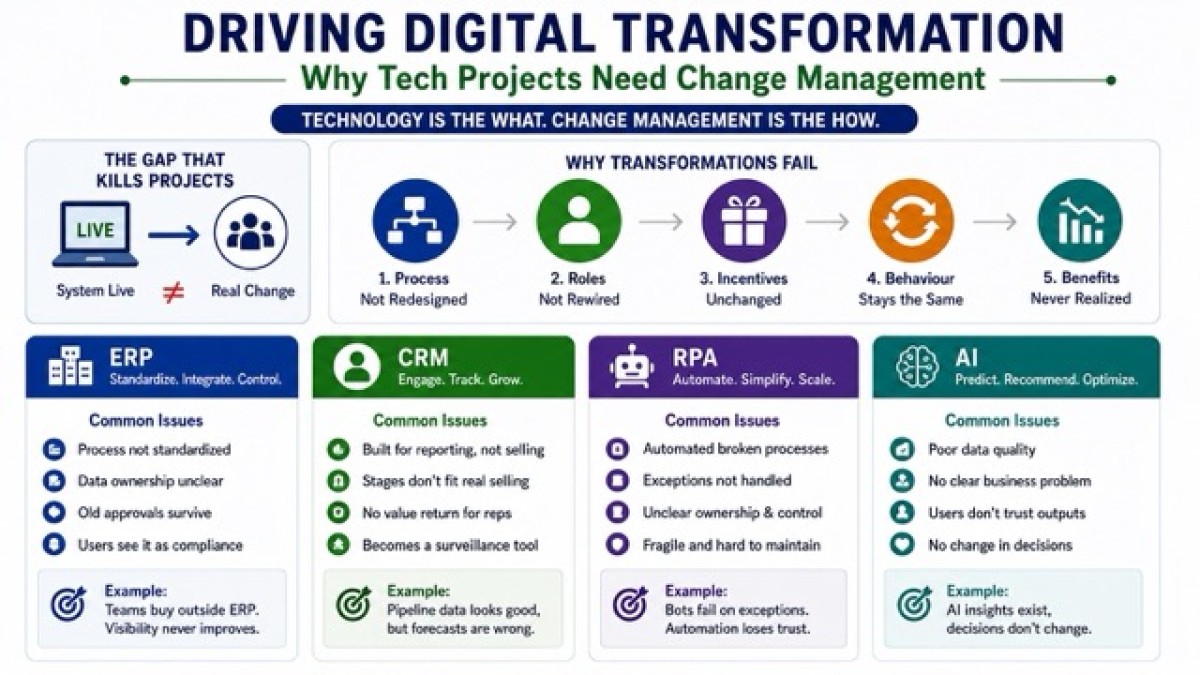
Tech go-live isn’t success—change management closes the adoption–value gap.

Digital transformation has a favourite lie.
It says: "If we pick the right tool, the business will change."
So, we buy an ERP, implement a CRM, automate work with RPA, and sprinkle AI across operations. We run sprints. We go live. We train people once. We celebrate.
Then adoption stalls. Workarounds multiply. Data quality collapses. Old habits quietly return. Leaders start saying the most expensive sentence in transformation:
"The system is live, but nothing has changed."
That gap between "live" and "changed"; is where tech projects go to die. And it rarely dies because the technology was incapable. It dies because people and processes were treated as "soft stuff" to handle later.
The uncomfortable truth: tech projects fail human-first, not tech-first
Most digital initiatives don't fail in the data centre. They fail on the shop floor, at the front desk, in the sales call, inside the finance checklist, and in the unwritten rules of "how work really gets done."
Here's the pattern you'll recognise:
- The tool is implemented, but the process is not redesigned.
- The process is redesigned, but the roles are not rewired.
- The roles are rewired, but the incentives are unchanged.
- The incentives are unchanged, so behaviour stays the same.
- Behaviour stays the same, so benefits never show up.
Technology is the "what." Change management is the "how humans actually adopt what."
Why ERP, CRM, RPA, and AI often fail (and it's not because of technology)
1) ERP failures: "We installed standardisation. The organisation rejected it."
An ERP isn't just software. It is a forced conversation about:
- Standard processes,
- Shared data definitions,
- Decision rights,
- Controls and approvals,
- Role clarity.
Common ERP failure modes (people + process):
- Process standardisation is negotiated into irrelevance. Every function wants "just one exception." You end up building a customised mess that is expensive and fragile.
- Master data ownership is unclear. No one "owns" item codes, customer records, vendor masters; so, duplicates, errors, and mismatches explode.
- Legacy approvals survive inside the new system. People recreate old paper-based approvals through emails and screenshots.
- Users treat ERP like compliance, not capability. They do minimum entries "to satisfy audit," not to run the business.
Example: A construction / EPC firm rolls out ERP for procurement-to-pay. The system works. Yet site teams keep buying outside ERP because vendor onboarding takes too long, material codes aren't available, and approvals are unclear. The ERP becomes the after-the-fact recording tool, not the operating system of procurement. The CFO sees the spend only when it's already committed. The "visibility" benefit never arrives.
Root cause: Not software. It's missing process redesign, decision rights, data governance, and role enablement.
2) CRM failures: "Salespeople don't hate CRMs. They hate pointless admin."
A CRM fails when it becomes a reporting machine for managers rather than a selling tool for sellers.
Common CRM failure modes (people + process):
- Field definitions are designed for dashboards, not for selling.
- Sales stages are theoretical. Real selling is messy; the CRM forces fake updates.
- Data entry has no clear "value return." Reps don't see what's in it for them.
- Managers inspect activity, not outcomes. The CRM becomes surveillance, not support.
- Adoption is uneven. Top performers avoid it; average performers fill it with garbage.
Example: A B2B services company implements CRM to improve pipeline predictability. Six months later, forecasts are still wrong, because sales teams update opportunities at month-end to satisfy reporting. The CRM is "complete" but not "true."
Root cause: not the CRM tool. It's incentives, workflow design, and trust.
3) RPA failures: "We automated chaos and called it transformation."
Robotic Process Automation works best when a process is stable, rules-based, and exception-light.
RPA fails when used as a band-aid for broken processes.
Common RPA failure modes (people + process):
- Process isn't standardised first. The bot is built on one team's version of the work.
- Exceptions aren't engineered. Humans keep rescuing the bot.
- Controls and accountability are unclear. Who owns bot errors? Who monitors?
- Upstream systems change. A small UI change breaks the automation.
- Fear and sabotage appear. People "protect" jobs by withholding inputs or creating exceptions.
Example: A finance team automates invoice posting with RPA. Initially, cycle time improves. Then vendors change invoice formats, PO mismatches rise, and exceptions spike. The bot becomes a fragile creature that needs constant nursing. Users say, "Automation doesn't work here."
Root cause: not RPA. It's process quality, exception management, and operating discipline.
4) AI failures: "The model is smart. The organisation is not ready."
AI initiatives fail for different reasons than ERP or CRM. The technology may work—yet the organisation cannot operationalise it safely and consistently.
Common AI failure modes (people + process):
- Low-quality data + unclear definitions. Garbage in becomes confident garbage out.
- No trust. Users don't understand how outputs are produced and don't act on them.
- Poor workflow integration. AI sits in a dashboard; people keep working in old tools.
- No governance. Decisions about bias, explainability, escalation paths are missing.
- Accountability is unclear. When AI is wrong, who is responsible?
Example: A lending / credit team deploys an AI model to flag risky applications. Analysts ignore it because they don't trust the score, managers cannot explain it, and there's no standard procedure for overrides. The model becomes an optional "second opinion." Impact stays small.
Root cause: not "AI accuracy" alone. It's trust, decision workflow design, and governance.
The real killer: the Adoption–Value Gap
Here's the simplest way to understand why change management is non-negotiable:
Digital transformation value = Technology capability × Human adoption × Process discipline
If adoption is low, value collapses; even with the best tool. And "adoption" isn't training completion.
Adoption means:
- People use the tool,
- Use it correctly,
- Use it consistently,
- And the new behaviour becomes the default.
That last part; default is what change management protects.
Unique change challenges in digital initiatives (and how to address them)
Digital change isn't just "bigger." It is different. It carries a distinct set of change risks.
1) The speed problem: delivery moves faster than behaviour
Digital teams iterate quickly. Human systems-habits, beliefs, informal power-move slower.
What to do:
- Build a release-based change plan (not one big "go-live" plan).
- For each release,
Define:
- Impacted roles,
- New behaviours,
- Job aids,
- Communications,
- Adoption measures,
- Hypercare plan.
Practical tactic: a "Change Pack" per release, owned jointly by Product + Change Lead.
2) The invisibility problem: work changes quietly, so resistance is delayed
In many digital programs, changes arrive incrementally. People don't resist early; they resist when pain accumulates.
What to do:
- Run structured impact assessments early and update them continuously.
- Do not ask "Will this change your work?" Ask:
- "What decisions will change?"
- "What approvals will move?"
- "What data will you now own?"
- "What mistakes will be more visible?"
3) The identity problem: digital tools expose competence gaps
A new system threatens professional identity. People fear looking slow, wrong, or outdated.
What to do:
- Train for confidence, not completion.
- Design "safe practice" environments.
- Use peer coaching: floor-walkers, champions, buddy system.
- Publicly normalise the learning curve ("expect errors in week 1–2; here's how we recover").
4) The control problem: digital systems change power and decision rights
ERP centralises. CRM standardises. RPA removes "manual control points." AI reshapes judgement. This triggers political resistance.
What to do:
Make decision
rights explicit:
- Who can approve,
- Who can override,
- Who owns master data,
- Who owns exception handling.
Put it in a Decision Rights Matrix and get sponsor sign-off.
5) The data problem: the organisation wants insights without doing data work
Digital systems punish sloppy data discipline. If the organisation historically tolerated "approximate" data, the new tool becomes "bad" overnight.
What to do:
Treat data as a change stream:
- Master data governance,
- Naming conventions,
- Ownership,
- Quality thresholds,
- Audit routines.
Introduce data KPIs (simple, visible, enforceable):
- Duplicate rate,
- Completeness,
- Timeliness,
- Exception backlog.
6) The exception problem: real operations are messy, but systems like clean rules
Digital solutions often assume predictable workflows. Reality is full of edge cases.
What to do:
Build an Exception Playbook:
- Common exceptions,
- Resolution steps,
- Escalation paths,
- Time limits,
- Authority levels.
Measure exceptions weekly and treat them as process improvement backlog not "user mistakes."
7) The parallel-run trap: old and new systems run together too long
People keep the old way "just in case." That safety net becomes the main road.
What to do:
Define clear cutover rules:
- What stops on Day 1,
- What can run for X weeks only,
- What is prohibited after a date.
Remove easy workarounds (access controls, form retirement, approval routing).
8) The vendor-led narrative: "The tool will solve it" becomes the strategy
Vendors sell features. Organisations need behavioural adoption.
What to do:
- Separate configuration decisions from change decisions.
- Use a "Feature-to-Behaviour Map":
- Feature: automated approval workflow
- Behaviour: managers approve in-system within 24 hours
- Reinforcement: SLA + dashboard + escalation
9) AI's special challenge: trust, ethics, and accountability
AI introduces new fears:
- "Will it replace me?"
- "Can it be wrong and still look confident?"
- "Will I be blamed for following it or ignoring it?"
What to do:
Establish human-in-the-loop rules:
- When AI can recommend,
- When humans must decide,
- When escalation is mandatory.
Provide explainability at the level users need:
- "Why this was flagged"
- "Top factors"
- "What to do next"
Train leaders to talk about AI without hype or threat.
What change management looks like inside a tech program
Not posters. Not one training session. Not "send a mail." Change management for digital initiatives is an operating system with four disciplines.
1) Adoption Architecture. Define the behaviours that create value.
- What must each role do differently?
- What must stop?
- What new decisions happen where?
- What does "good usage" look like?
Output: Role-based behaviour maps + proficiency definitions.
2) Change Governance. Digital programs need governance that is fast, not bureaucratic.
Minimum viable governance:
- Sponsor: owns business outcomes, clears barriers.
- Steering group: resolves cross-functional conflicts quickly.
- PMO / Transformation Office: integrates plan, risk, dependencies.
- Change Champions network: local adoption, feedback, coaching.
- Data owners + process owners: accountable for integrity.
Output: Decision cadence + escalation rules.
3) Enablement and Performance Support. Training is necessary. It is not sufficient. Use a layered approach:
- Role-based training (scenario-driven, not feature-driven)
- Job aids (one-page "how to" guides)
- In-app guidance where possible
- Floor support during go-live
- Reinforcement sessions after real usage begins Output: Training plan + job aids + hypercare support model.
4) Reinforcement and Measurement
If you don't measure adoption, you will manage opinions. Track:
- Utilisation: are people using the tool?
- Proficiency: are they using it correctly?
- Process outcomes: cycle time, error rate, rework, exception volume
- Business outcomes: revenue, working capital, customer retention, risk reduction
Output: Adoption dashboard that leaders review weekly.
A practical playbook: the 7 moves that prevent digital failure
Move 1: Start with "value behaviours," not features. Instead of "we implemented CRM stages,"
define:
"Sales updates next-step commitments within 24 hours of a customer interaction."
Move 2: Run impact assessments like a living document. Update impacts each sprint / release. Don't
freeze them in a slide deck.
Move 3: Build the champions network early. Champions aren't cheerleaders.
They are:
- Local translators,
- Feedback collectors,
- Peer coaches,
- Early-warning sensors.
Move 4: Fix process before automating it. If you automate a broken process, you get broken outcomes faster.
Move 5: Make data ownership non-negotiable. Without data governance, ERP / AI becomes blame theatre:
- "The system is wrong"
- "The data is wrong"
- "The users are wrong" Pick owners. Define standards. Audit.
Move 6: Design cutover to kill parallel habits. People do what is easiest. Design "easy" to be the new way.
Move 7: Reinforce through managers, not messages. If managers don't coach the new behaviour weekly, it won't stick.
Give managers:
- Adoption dashboards,
- Coaching prompts,
- Escalation levers,
- Recognition mechanisms.
Mini-case examples: what "change-managed" digital looks like
ERP example: procurement discipline becomes visible and enforceable
- Process redesigned: requisition → approval → PO → GRN → invoice match
- Decision rights clarified: who approves what, who can override
- Data governance: item codes created via SLA with ownership
- Reinforcement: spend outside ERP is reported weekly with reasons
Result: ERP becomes the operating system, not a reporting afterthought.
CRM example: adoption increases when sellers gain value
- Fields reduced to what improves selling
- Stages aligned to real buyer journey
- Automation removes admin (templates, reminders, call logging)
- Managers coach deal quality, not activity volume
Result: forecasts improve because the CRM becomes truth, not theatre.
RPA example: automation works after standardisation
- Process simplified and standardised
- Exceptions engineered with clear human handoffs
- Bot monitoring roles created •Performance measured: exception rate, cycle time, rework
Result: RPA delivers stable savings, not fragile demos.
AI example: trust is built through governance and workflow integration
- AI outputs embedded where decisions happen (not a separate dashboard)
- Clear rules for override and escalation
- Analysts trained on "how to use AI responsibly"
- Feedback loop: false positives / negatives drive model improvements
Result: AI becomes part of operations, not a side experiment.
The checklist leaders should use before approving any tech go-live
If you can't answer these clearly, you're going live into chaos:
- What specific behaviours must change by role?
- What will stop, and how will we prevent workarounds?
- Who owns master data, exceptions, and process compliance?
- What does "good usage" look like, and how will we measure it weekly?
- What is the hypercare model (people, hours, escalation)?
- How will managers reinforce new behaviours in the first 90 days?
- What are the top 10 adoption risks and mitigations?
Closing insight: digital transformation is not a software launch
A tech team can deliver a system. Only the organisation can deliver a change.
ERP, CRM, RPA, and AI are amplifiers. They amplify clarity or confusion. Discipline or disorder. Trust or suspicion. Ownership or avoidance. So, the real question isn't: "Is the technology ready?"
It's: "Are our people and processes ready to live differently?" If you treat change management as optional, your digital program will become an expensive IT milestone.
If you treat change management as the core operating engine, your tech investment becomes what it was supposed to be: A measurable shift in how work gets done and how value is created.
Categories: : Leadership