Gamification of Process & Change
 ACTSol and Associates
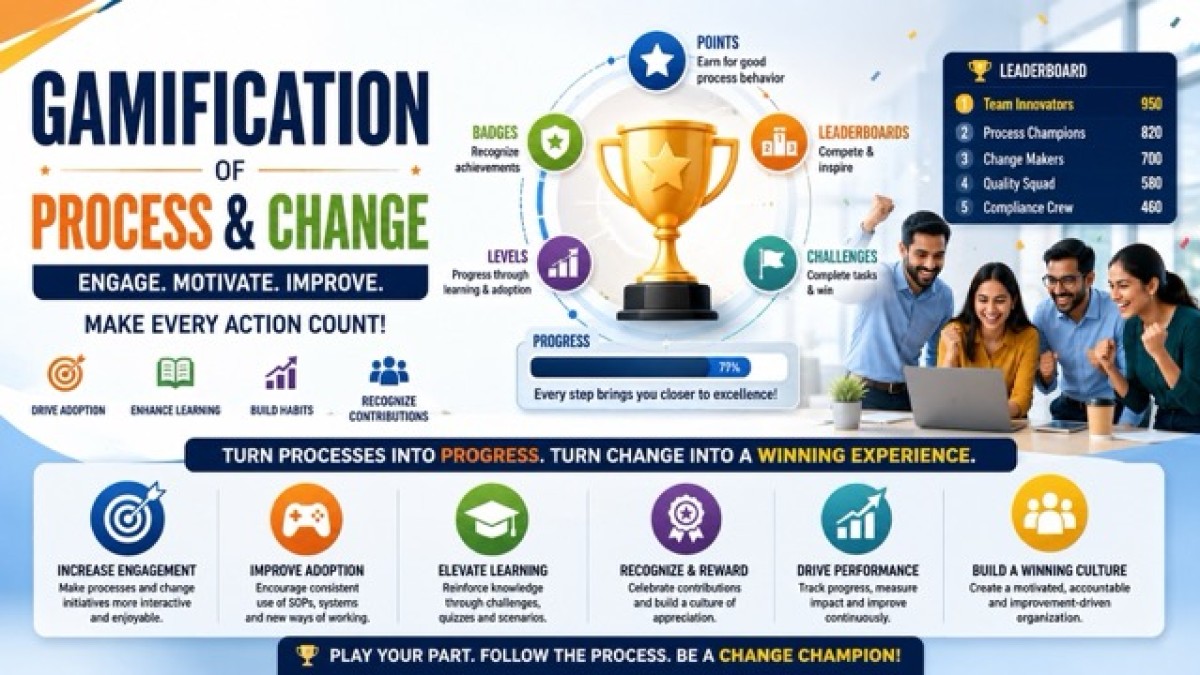
How gamification boosts process and change adoption: points, badges, challenges, and dashboards for training, compliance, and continuous improvement.

In many organizations, process improvement and change management are treated as serious, structured, and compliance-driven activities. There are SOPs to follow, audits to complete, training modules to attend, dashboards to review, and improvement actions to close. All these are important. Yet, despite good intentions, many such initiatives struggle because people experience them as additional work rather than meaningful participation.
This is where gamification can make a practical difference.
Gamification does not mean converting work into a game. It means using selected elements of games—such as points, badges, levels, progress bars, leaderboards, challenges, recognition, and rewards—to make process and change initiatives more engaging, visible, and motivating.
When used thoughtfully, gamification can help employees participate more actively in process adoption, training, audits, compliance, and continuous improvement initiatives.
In the broader journey of process and change management, gamification belongs naturally to the future of work, where organizations must make workflows, learning, and adoption more engaging for hybrid, digital, and distributed teams. It is also listed as a key theme under the “Future of Work & Hybrid Organizations” cluster in the blog series framework.
Why Process and Change Initiatives Need Engagement
Most process initiatives fail not because the SOP is badly written, but because people do not consistently follow it. Most change initiatives slow down not because the strategy is wrong, but because people do not feel involved, motivated, or recognized.
Employees may ask silently:
- “Why should I change my way of working?”
- “What benefit will I get?”
- “Is anyone noticing my effort?”
- “Will this become another management drive that disappears after a few weeks?”
Traditional process management often answers these questions through instructions, emails, meetings, and escalation. These are necessary, but they may not be enough. People need clarity, feedback, encouragement, and a sense of progress. Gamification can provide these elements in a structured manner.
When employees can see their progress, earn recognition, complete challenges, compare team performance, and celebrate small wins, process discipline becomes less mechanical and more participative.
Gamification in Process Adoption
Process adoption means getting people to use a new or improved process in daily work. This may involve following an SOP, using a new system, submitting records on time, raising tickets properly, using checklists, or adhering to approval workflows.
Gamification can support adoption by making the desired behaviours visible and measurable.
For example, a company implementing a new purchase requisition process may introduce a monthly “process adoption score” for departments. The score may consider:
- Timely PR submission
- Correct documentation
- Reduction in rework
- Use of approved templates
Closure of queries within defined timelines Departments with high scores may receive recognition during monthly reviews. Individual users who consistently follow the new process may receive digital badges such as “PR Champion” or “First-Time-Right Contributor.”
This simple mechanism changes the conversation. Instead of only saying “follow the SOP,” the organization starts showing progress, appreciating effort, and creating positive peer influence.
Gamification can also help during the early stages of change. When a new process is launched, employees often make mistakes. Instead of treating every mistake as failure, organizations can create learning levels. For example:
- Level 1: Understand the process
- Level 2: Use the process correctly
- Level 3: Help others use the process
- Level 4: Suggest improvements
This gives employees a sense of movement and achievement. It also helps managers identify change champions who can support others.
Gamification in Training
Training is one of the most obvious areas where gamification can help. Many employees attend process training because it is mandatory. They may complete the session but fail to retain or apply the learning. Gamification can make training more interactive, practical, and memorable.
Instead of a long one-way SOP training session, organizations can use quizzes, scenarios, simulations, case-based challenges, and role-based learning paths.
For example, during training on incident reporting, employees may be given practical workplace scenarios:
- A delivery delay occurs due to wrong documentation.
- A machine breakdown affects production.
- A customer complaint is received but not logged.
- A safety observation is noticed but ignored.
Participants can be asked to identify whether it is an incident, near miss, non-conformity, complaint, or improvement opportunity. Points can be awarded for correct classification, root cause thinking, and appropriate escalation.
This makes learning active. Employees are not just listening; they are applying.
Training dashboards can also show completion percentage, assessment scores, improvement over time, and department-wise participation. Digital badges such as “SOP Ready,” “Audit Aware,” “Compliance Champion,” or “RCA Practitioner” can create a sense of accomplishment.
However, the goal should not be only to complete training. The real objective is application. Therefore, training gamification should connect with workplace behaviour. For example, an employee who completes SOP training and applies the SOP correctly for 30 days may receive higher recognition than someone who only scores well in a quiz.
Gamification in Audits
Internal audits are often viewed with anxiety. Employees may see audits as fault-finding exercises. Auditors may struggle to get cooperation. Process owners may become defensive when gaps are identified.
Gamification can help shift audits from fear to participation.
Instead of presenting audits only as compliance checks, organizations can design audit readiness challenges. Departments may be encouraged to maintain records, close previous audit observations, conduct self-checks, and improve process adherence before the formal audit.
A simple audit readiness dashboard may include:
- Open audit points
- Overdue corrective actions
- Self-audit completion Document availability
- Evidence quality
- Repeat observations
Departments can be recognized for “Zero Repeat NCs,” “Fastest CAPA Closure,” “Best Evidence Management,” or “Most Improved Audit Score.”
This does not mean audit findings should be softened. Audit integrity must remain strong. But gamification can make departments more proactive. It encourages teams to prepare, improve, and take ownership before the auditor arrives.
Gamification can also improve participation in self-audits. Many organizations introduce checklists but struggle to get them used sincerely. A monthly self-audit challenge can encourage teams to complete checks on time, identify genuine gaps, and close actions.
The key is to reward transparency, not hiding of problems. A department that honestly reports five issues and closes them should be appreciated more than a department that reports no issues without evidence.
Gamification in Compliance
Compliance is one of the most sensitive areas for gamification. It includes statutory requirements, safety norms, quality standards, data protection, financial controls, HR policies, and ethical practices.
Gamification can help increase awareness and timely action, but it must be designed carefully.
For example, compliance calendars can be converted into visual dashboards showing due dates, responsible persons, completion status, and risk levels. Teams may receive recognition for timely statutory submissions, policy acknowledgements, training completion, or closure of compliance gaps.
A “compliance challenge month” may focus on one theme, such as data privacy, workplace safety, documentation discipline, or contract compliance. Employees may participate in short quizzes, scenario-based exercises, and reporting drives.
Examples of gamified compliance activities include:
- A safety observation challenge where employees report unsafe conditions
- A data security awareness quiz with practical examples
- A documentation discipline campaign for correct filing and record retention
- A policy acknowledgement dashboard for HR and governance policies
- A contract compliance tracker for procurement and legal teams
Rewards in compliance should be meaningful but not excessive. The message should be clear: compliance is not optional, and rewards are for proactive discipline, not for doing the bare minimum.
Gamification should never trivialize serious obligations. A safety violation, financial control failure, or legal non-compliance cannot be treated as a game. The gamified layer should support awareness and participation, while accountability remains firm.
Gamification in Improvement Initiatives
Continuous improvement requires ideas, participation, experimentation, and follow-through. Many organizations launch suggestion schemes, Kaizen programs, or improvement drives, but participation reduces over time because employees feel their ideas are ignored.
Gamification can revive improvement culture.
Employees can earn points for submitting improvement ideas, participating in problem-solving, supporting implementation, validating results, and sharing learning. However, points should not be given merely for the number of ideas. Quality matters.
A useful scoring model may consider:
- Relevance of the idea
- Practicality of implementation
- Impact on cost, quality, time, safety, or customer experience
- Cross-functional collaboration
- Sustainability of results Replication potential
Teams may be recognized for “Best Kaizen,” “Highest Impact Improvement,” “Most Practical Idea,” “Best Cross-Functional Collaboration,” or “Most Replicable Solution.”
Dashboards can show improvement pipeline status: ideas submitted, ideas approved, ideas implemented, benefits realized, and pending actions. This builds transparency and prevents suggestion schemes from becoming symbolic. Gamification can also support problem-solving methods such as RCA, 5 Why, Fishbone, Pareto, 5S, Lean, and Six Sigma. Teams can be given challenges such as reducing rework, improving turnaround time, reducing customer complaints, or improving audit scores. When improvement is converted into visible challenges, people see change as something they can contribute to—not just something imposed by management.
Rewards and Recognition
Rewards are an important part of gamification, but they must be handled carefully. If rewards are too small, they may not motivate. If they are too large, they may create unhealthy competition or manipulation.
Recognition is often more powerful than monetary rewards. Employees value appreciation when it is timely, specific, and visible.
Possible reward mechanisms include:
- Certificates
- Digital badges
- Recognition in town halls
- Team appreciation notes
- Dashboard visibility
- Learning opportunities
- Special project participation
- Small non-monetary rewards
Leadership appreciation The best rewards are connected to meaningful behaviours. For example, instead of rewarding only the highest score, organizations can reward improvement, consistency, collaboration, and transparency.
This is important because process and change initiatives are team-based. If only top performers are rewarded, others may lose interest. Recognition should encourage broad participation.
Organizations can create categories such as:
- Most improved department
- Best first-time-right performance
- Best audit closure discipline
- Best process adoption support
- Best improvement idea
- Best change champion
- Best compliance ownership
Such categories allow different teams and individuals to contribute in different ways.
Dashboards: Making Progress Visible
Dashboards are central to gamification. Without visibility, gamification becomes informal and subjective. Dashboards show progress, gaps, rankings, trends, and achievements.
A good gamification dashboard should be simple, fair, and behaviour-focused. It should not become another complicated MIS report.
For process and change initiatives, dashboards may show:
- Training completion
- Assessment scores
- SOP adoption status
- Audit findings and closures
- Compliance due dates
- Improvement ideas
- CAPA closure status
- User participation
- Department performance
- Change readiness indicators
Dashboards can use progress bars, levels, status indicators, and trend lines. However, the design must be mature. The purpose is not to embarrass poor performers but to create constructive visibility.
Dashboards should also show context. For example, a department handling complex processes may have more audit observations than a smaller department. A raw leaderboard may be unfair unless process complexity and workload are considered.
Therefore, dashboards should combine performance with interpretation. Managers must use them for coaching, not only comparison.
Challenges and Campaigns
Challenges are one of the most effective ways to apply gamification. A challenge gives employees a focused objective for a defined period.
Examples include:
- 30-day SOP adoption challenge
- Zero overdue CAPA challenge
- Audit readiness week
- Safety observation month
- Documentation discipline drive
- Customer complaint reduction challenge
- 5S workplace improvement challenge
- Digital system usage challenge
- Compliance awareness quiz week
Challenges work because they create urgency and shared focus. They also help break large change initiatives into smaller, achievable actions.
For example, instead of saying “improve documentation discipline,” an organization can run a “10-day document control challenge.” Each department may check whether formats are updated, records are filed, obsolete documents are removed, and approvals are traceable. The results can be displayed on a dashboard and reviewed by leadership.
This converts a vague expectation into a practical activity.
Risks of Gamification
Gamification can create strong engagement, but it also has risks.
- The first risk is superficial participation. Employees may focus on earning points rather than improving the process. For example, they may complete training quickly without learning properly.
- The second risk is manipulation. If rewards are linked only to numbers, people may game the system. They may submit many low-quality ideas, hide audit issues, or close actions without proper evidence.
- The third risk is unhealthy competition. Leaderboards can motivate some people but discourage others. Departments may stop sharing knowledge if they feel they are competing.
- The fourth risk is unfair measurement. If scoring criteria are unclear or biased, employees may lose trust.
- The fifth risk is trivializing serious matters. Compliance, safety, ethics, and quality cannot be reduced to playful activities. Gamification should support seriousness, not dilute it.
- The sixth risk is fatigue. Too many badges, campaigns, and challenges can become noise. Employees may start ignoring them if every initiative is gamified.
To avoid these risks, organizations must design gamification with maturity. The system should reward meaningful behaviours, evidence-based performance, collaboration, and sustained improvement.
Principles for Effective Gamification
Good gamification should follow a few practical principles.
- Link it to business objectives. Do not gamify for entertainment. Gamify to improve adoption, learning, compliance, audit readiness, or improvement participation.
- Reward quality, not just quantity. A few meaningful improvement ideas are better than many weak suggestions.
- Make rules transparent. Employees should know how points, badges, scores, and rankings are calculated.
- Balance individual and team recognition. Process improvement depends on collaboration.
- Use dashboards for learning, not blame. Visibility should create ownership and support.
- Keep it simple. Over-designed gamification becomes difficult to manage.
- Review and improve the system. What motivates people today may not work after six months.
Conclusion
Gamification can make process and change initiatives more engaging, participative, and sustainable. It helps employees see progress, receive recognition, learn actively, participate in audits, follow compliance requirements, and contribute to improvement initiatives.
However, gamification is not a substitute for leadership, process clarity, accountability, or culture. It is an enabler. If the underlying process is confusing, gamification will not solve the problem. If leadership does not take change seriously, badges and points will not create discipline. If rewards are unfair, the system will lose credibility.
The real power of gamification lies in making the right behaviours visible, appreciated, and repeated. When employees experience process discipline as progress rather than pressure, participation improves. When change feels like a shared challenge rather than a forced instruction, adoption becomes easier. Used wisely, gamification can convert process and change management from a compliance-driven activity into a culture-building journey.
Categories: : Governance