Lean Six Sigma Meets Modern Change Agility
 ACTSol and Associates
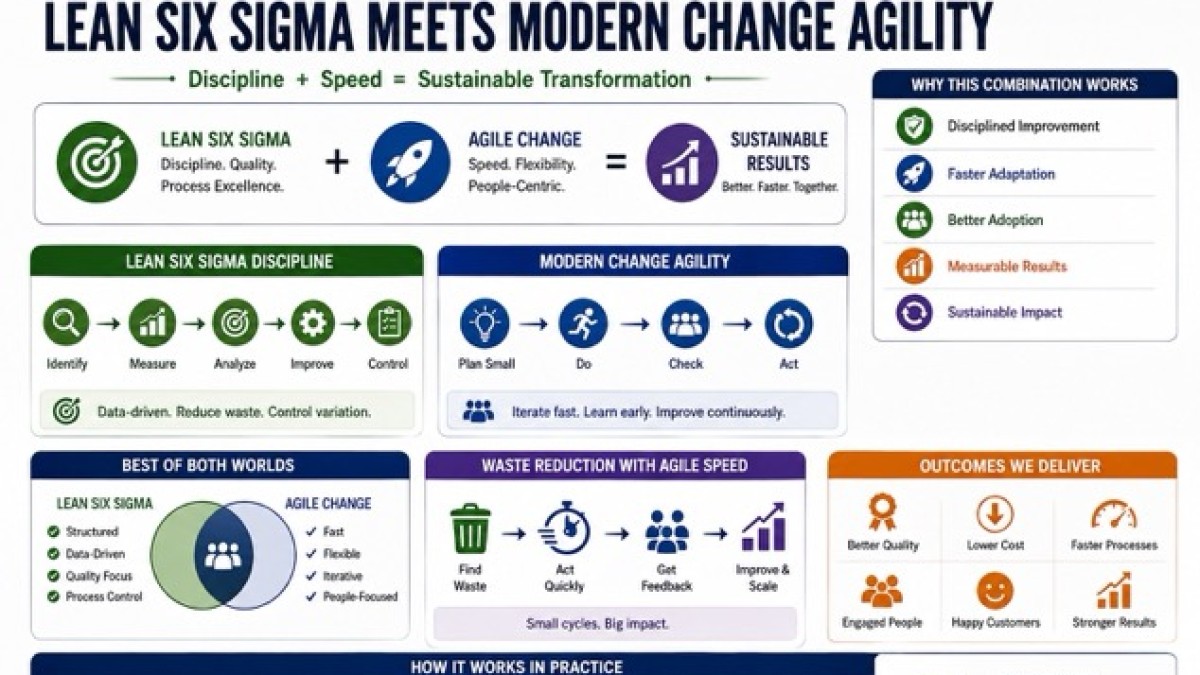
Combine Lean Six Sigma discipline with agile speed for faster, measurable, sustainable transformation.

Building Discipline, Speed, and Sustainable Business Transformation Organizations today are under pressure to improve faster than ever before. Customers expect better quality, quicker service, lower cost, and more responsive experiences. Leaders want operational efficiency, digital maturity, and measurable business outcomes.
Employees, on the other hand, need clarity, involvement, and practical support while adapting to new ways of working. In this environment, traditional improvement methods alone may feel too slow, while purely agile approaches may sometimes lack sufficient discipline, measurement, and control.
This is where the powerful combination of Lean Six Sigma and modern change agility becomes highly relevant. Lean Six Sigma brings structure, data, waste reduction, variation control, root cause analysis, and process discipline.
Agile change methods bring speed, flexibility, iteration, stakeholder feedback, and faster adoption. Together, they create a balanced transformation approach: disciplined enough to sustain improvements and agile enough to respond to changing business realities.
This topic forms a natural part of the broader theme of Agile, Lean & Continuous Improvement, where structured methods are blended with adaptive, modern practices.
Understanding Lean Six Sigma Discipline
Lean Six Sigma is a proven methodology for improving processes by reducing waste, defects, delays, variation, and inefficiencies. Lean focuses on eliminating non-value-added activities, while Six Sigma focuses on reducing variation and improving process capability. Together, they help organizations improve quality, speed, cost, reliability, and customer satisfaction.
Lean asks:
What activities are consuming time, effort, resources, or money without adding value?
Six Sigma asks:
Why is the process inconsistent, and how can variation be reduced?
In practical terms, Lean Six Sigma helps organizations identify process gaps, study data, analyze root causes, redesign workflows, standardize best practices, and monitor performance. It uses tools such as value stream mapping, DMAIC, root cause analysis, control charts, Pareto analysis, fishbone diagrams, standard work, visual management, and mistake-proofing.
However, traditional Lean Six Sigma projects can sometimes become documentation-heavy, analysis-heavy, and slow-moving. In a fast-changing business environment, organizations may not always have the luxury of long improvement cycles. Business teams need faster testing, quicker decisions, and visible progress. This is where change agility strengthens Lean Six Sigma.
What Modern Change Agility Adds
Modern change agility is about helping organizations adapt quickly, learn continuously, and implement improvements through small, practical, iterative steps. It encourages frequent feedback, cross-functional collaboration, experimentation, employee involvement, and rapid course correction.
Instead of designing a perfect solution in isolation and implementing it after months of planning, agile change methods encourage teams to create a workable solution, test it, learn from users, improve it, and scale it gradually.
Agile change asks:
What is the smallest useful improvement we can implement now?
It also asks:
How quickly can we learn whether this change is working?
This approach is especially useful when business conditions are uncertain, technology is evolving, customer needs are changing, or employees are struggling with adoption. Agile change does not reject structure. Rather, it makes structure more practical, responsive, and people-centered.
Why Lean Six Sigma and Agile Change Fit Together
At first glance, Lean Six Sigma and agile change may look different. Lean Six Sigma is often seen as structured, analytical, and data-driven. Agile change is seen as flexible, fast, and adaptive. But in reality, both share a common purpose: improving business performance.
Lean Six Sigma ensures that improvement is not based on guesswork. It helps teams understand the actual process, identify root causes, reduce waste, control variation, and build standardization. Agile change ensures that improvements do not remain stuck in analysis. It helps teams implement faster, get feedback from users, and refine solutions in real working conditions.
- Lean Six Sigma provides the discipline of improvement.
- Agile change provides the speed of adoption.
- Lean Six Sigma helps organizations avoid random action.
- Agile change helps organizations avoid slow action.
When combined properly, they help leaders achieve practical transformation that is measurable, fast, and sustainable.
Waste Reduction with Agile Speed
Waste is one of the central concerns of Lean. Waste may appear in many forms: waiting time, excess approvals, rework, overprocessing, unnecessary movement, duplication of effort, unclear handoffs, excess inventory, and underutilized talent. In service organizations, waste may also appear as repeated follow-ups, manual data entry, unclear decision rights, multiple versions of documents, and avoidable escalations.
A traditional Lean approach may map the entire process, identify all waste points, and then redesign the complete process. This is useful, but it can take time. An agile change approach makes waste reduction faster by breaking the improvement journey into smaller cycles.
For example, instead of redesigning the entire procurement process at once, an organization may begin with one high-impact waste area: delay in purchase approvals. The team can identify approval bottlenecks, test a simplified approval matrix, collect feedback from users, and measure whether cycle time improves. Once the solution works, it can be refined and expanded to other procurement categories.
This approach prevents improvement fatigue. Employees do not have to wait months to see results. Leaders get early evidence of progress. Teams gain confidence because improvement becomes visible and practical.
Variation Control Without Slowing Down Execution
Variation is one of the biggest enemies of process excellence. When the same process is performed differently by different people, departments, branches, or locations, the organization faces inconsistent quality, unpredictable turnaround time, customer dissatisfaction, and weak control.
Six Sigma helps reduce variation by using data, measurement, root cause analysis, and standardization. It focuses on understanding why outputs differ and how the process can become more stable.
However, excessive standardization without agility can create rigidity. Employees may feel that procedures are imposed on them without considering practical realities. This can lead to resistance, workarounds, and poor adoption.
Agile change methods help solve this problem by involving users early. Instead of finalizing an SOP or process standard only at the leadership level, the organization can test the standard with actual users. Teams can ask: Is this step practical? Is the checklist useful? Is the approval flow realistic? Does the system support the process? What exceptions commonly occur?
This feedback helps create standards that are not only technically correct but also usable. Variation is reduced not by forcing compliance, but by designing processes that people can actually follow.
Faster Execution Through Iterative Improvement
One of the common challenges in transformation projects is the gap between planning and execution. Many organizations spend significant time preparing strategy documents, process maps, SOPs, dashboards, and implementation plans. But actual adoption remains weak because execution is delayed or treated as a separate phase.
Modern change agility brings execution into the improvement cycle itself. It encourages teams to improve through short cycles, often called sprints, pilots, or iterations. Each cycle has a clear objective, defined deliverables, quick feedback, and visible learning.
For example, in a customer complaint management process, the organization may not wait to redesign the complete complaint lifecycle. It can start with a two-week improvement cycle focused only on complaint logging accuracy. The next cycle can focus on escalation timelines. The next can focus on root cause classification. Another cycle can focus on customer closure communication.
This makes transformation manageable. Large change is converted into smaller, structured improvements. Each improvement builds momentum for the next. Lean Six Sigma ensures that each cycle is connected to measurable business outcomes. Agile change ensures that each cycle moves quickly and remains close to the actual users.
Practical Business Transformation
Business transformation is not only about introducing new technology, restructuring departments, or launching strategic initiatives. Real transformation happens when processes, people, systems, data, and behaviours change together.
Lean Six Sigma contributes to transformation by improving process capability. It helps answer important questions: Where are the inefficiencies? What causes defects? Where does the delay occur? Which steps add value? Which metrics matter? What controls are required?
Agile change contributes by improving adoption capability. It helps answer equally important questions: Who will be affected? What support do employees need? What feedback are users giving? What behaviours must change? What resistance is emerging? How can we adjust quickly?
When both are combined, transformation becomes more practical. It is no longer a one-time project with a launch date. It becomes a disciplined journey of continuous improvement and continuous adoption.
For instance, a manufacturing company implementing digital quality checks may use Lean Six Sigma to reduce inspection errors, rework, and process variation. At the same time, it can use agile change methods to pilot the digital checklist with one production line, gather operator feedback, simplify screen design, train supervisors, and scale the solution gradually.
Similarly, a service company improving invoice processing can use Lean Six Sigma to identify rework, duplicate entries, approval delays, and payment errors. Agile change can help test a revised workflow with one business unit, collect feedback from finance users, improve system prompts, and refine the escalation process before wider rollout.
Balancing Structure and Flexibility
The real strength of this combined approach lies in balance. Too much structure can make improvement slow and bureaucratic. Too much agility can make change scattered and inconsistent. Organizations need both.
Structure is required for governance, measurement, accountability, risk control, and standardization. Flexibility is required for speed, learning, feedback, and adaptation.
Lean Six Sigma should not become a rigid methodology where teams follow tools mechanically. Agile change should not become an excuse for informal or unmeasured action. The two must support each other.
A practical combined model may look like this:
- Define the business problem clearly.
- Measure current performance with relevant data.
- Identify waste, variation, and root causes.
- Design improvement options.
- Pilot solutions quickly.
- Collect user feedback.
- Refine the process.
- Standardize what works.
- Train people. Monitor performance.
- Continue improving.
This model respects the discipline of DMAIC while making execution more iterative and responsive.
The Role of Leadership
Leaders play a critical role in combining Lean Six Sigma with change agility. They must create an environment where teams are encouraged to improve, experiment, measure, and learn. They should not demand perfect solutions before action begins. At the same time, they should not allow random changes without data and accountability.
Leaders must ask balanced questions:
- What problem are we solving?
- What data supports this problem?
- What waste or variation exists?
- What small improvement can we test first?
- What feedback are employees giving?
- What result has changed? What needs to be standardized?
- What needs further improvement?
This type of leadership encourages both discipline and speed. It also builds confidence among employees because change becomes participative, evidence-based, and practical.
People and Culture Matter
No improvement methodology succeeds without people. Lean Six Sigma may identify the best technical solution, but people must adopt it in daily work. Agile change may create fast movement, but people must trust the process.
Employees should be involved early in improvement projects. Their practical knowledge helps identify real waste, hidden variation, and implementation challenges. Frontline teams often know where delays happen, where customers complain, where systems create rework, and where SOPs are not practical.
When employees participate in improvement, resistance reduces. They begin to see change as something created with them, not imposed on them. This creates ownership.
A culture of continuous improvement grows when employees are encouraged to speak about problems, test ideas, use data, and improve their own work processes. Lean Six Sigma gives them the tools. Agile change gives them the rhythm.
Using Metrics Wisely
Measurement is essential, but organizations must choose metrics carefully. Lean Six Sigma uses metrics such as defect rate, cycle time, process capability, rework percentage, cost of poor quality, first-time-right performance, and variation levels. Agile change may use adoption rate, feedback scores, sprint completion, user readiness, training completion, and behavioural adoption indicators.
The best approach is to combine process metrics and change metrics.
For example, if a company improves its onboarding process, process metrics may include onboarding cycle time, document error rate, pending approvals, and first-time-right employee data. Change metrics may include HR user adoption, manager satisfaction, employee feedback, training completion, and usage of the new onboarding portal.
This combined measurement gives a fuller picture. A process may look improved on paper, but if users are not adopting it, transformation is incomplete. Similarly, employees may like a new system, but if it does not reduce defects or delays, process excellence is incomplete.
Common Mistakes to Avoid
Organizations should avoid treating Lean Six Sigma and agile change as competing approaches. They are complementary. Another mistake is using too many tools without solving real business problems. A fishbone diagram, control chart, sprint board, or feedback loop is useful only when it supports better decisions and better outcomes.
A third mistake is over-standardizing too early. If a process is standardized before testing, the organization may lock itself into an impractical design. On the other hand, continuous experimentation without standardization can create confusion. The key is to test quickly, learn quickly, and then standardize what works.
Another common mistake is ignoring the human side of variation. Variation is not always caused by poor discipline. It may be caused by unclear roles, system limitations, insufficient training, unrealistic SOPs, weak supervision, or conflicting priorities. Agile change methods help uncover these issues through feedback and involvement.
The Future of Improvement
The future of business improvement will not be purely Lean, purely Six Sigma, or purely agile. It will be integrated. Organizations will need process discipline, data intelligence, digital tools, employee participation, rapid experimentation, and strong governance.
Technology will also strengthen this integration. Process mining can identify actual process deviations. Automation can remove manual waste. Dashboards can monitor performance in real time. Digital adoption tools can guide employees while they work. AI can support decision-making, prediction, and root cause analysis.
But technology alone will not transform organizations. The real advantage will come from combining technology with Lean Six Sigma thinking and agile change execution.
Conclusion
Lean Six Sigma and modern change agility together offer a powerful approach for today’s organizations. Lean Six Sigma brings clarity, discipline, measurement, waste reduction, variation control, and standardization. Agile change brings speed, flexibility, feedback, collaboration, and faster adoption.
When these approaches are combined, organizations can move beyond slow improvement projects and fragmented change initiatives. They can create a practical transformation engine that identifies problems accurately, tests solutions quickly, engages people meaningfully, and sustains results over time.
In a world where business conditions keep changing, excellence cannot be achieved through rigid control alone. Nor can it be achieved through speed without discipline. The real opportunity lies in bringing both together.
Lean Six Sigma helps organizations do things right. Agile change helps organizations improve and adapt faster. Together, they help businesses transform in a way that is practical, measurable, and sustainable.
Categories: : Six Sigma Series