Lewin, Kotter & ADKAR: When to Use Which Change Model
 ACTSol and Associates
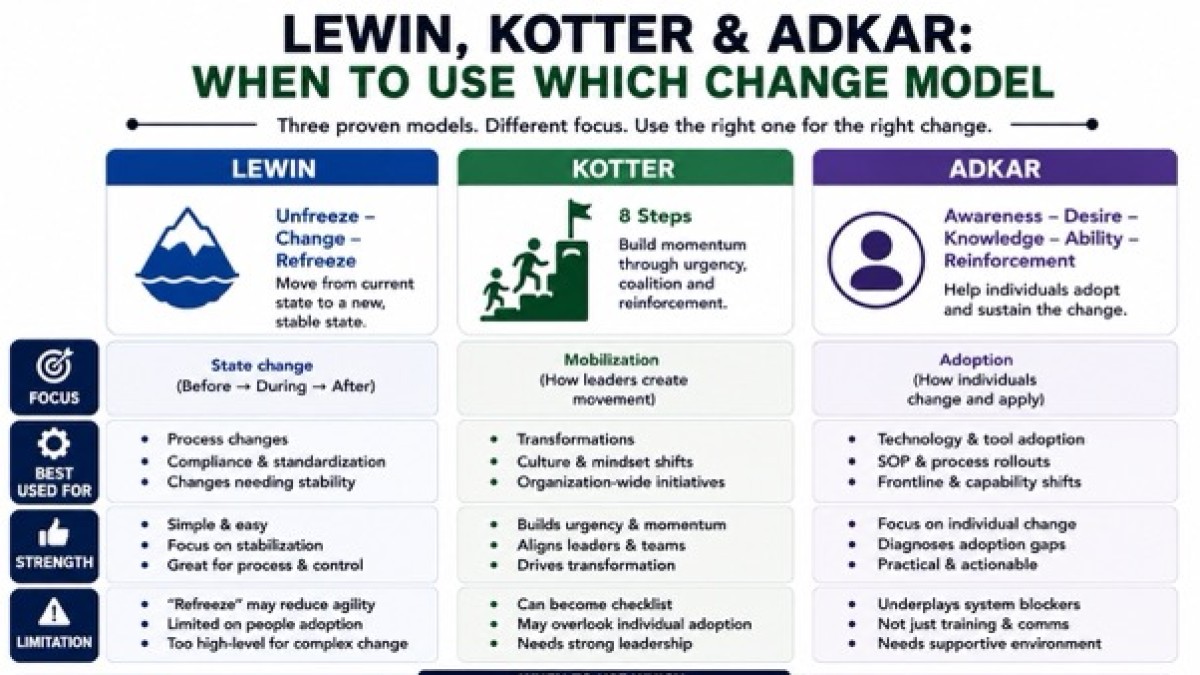
When to use Lewin, Kotter, or ADKAR—pick the model that fits the change.

Most change initiatives don't fail because the idea is wrong.
They fail because leaders pick the wrong type of change approach for the reality on the ground; then force-fit everyone into it. A new ERP is not the same as a culture reset. A merger integration is not the same as rolling out a new SOP. A "we need to move faster" speech is not the same as building actual urgency. And a model that works brilliantly in one organization can misfire in another; because every change model carries assumptions about how organizations behave, how people respond, and how power flows.
Lewin, Kotter, and ADKAR are the three most widely used change frameworks for a reason: each solves a different class of problem. If you know what each model is designed to control, you can select the right one or combine them without creating confusion.
This article compares their assumptions, strengths, and limitations, and then gives practical guidance (with examples) on selecting and blending them based on context and organizational maturity.
The 3 models in one sentence each:
Lewin (Unfreeze–Change–Refreeze): A phase-gated model that helps you destabilize the status quo, move to a new state, and stabilize it again.
Kotter (8 Steps): A leadership-driven transformation model that builds momentum through urgency, coalition, vision, and reinforcement.
ADKAR (Awareness-Desire-Knowledge-Ability-Reinforcement): An individual adoption model that diagnoses and fixes where people are stuck so change becomes real in day-to-day behaviour.
A simple way to remember this:
- a) Lewin = the "state change" view (before → during → after)
- b) Kotter = the "mobilization" view (how leaders create mass movement)
- c) ADKAR = the "adoption" view (how individuals actually change)
What each model assumes (and why that matters)
1) Lewin's assumptions
Lewin assumes:
- a) Organizations sit in a relatively stable "frozen" equilibrium.
- b) Change requires disrupting that equilibrium.
- c) Once the new way works, you can stabilize it into a new norm.
This works best when:
- a) You can clearly define the current state and future state.
- b) The operating environment allows a "settle" period.
- d) You need disciplined stabilization (controls, governance, standards).
Where it clashes with reality:
- a) In fast-moving environments, the organization never truly "refreezes."
- b) If leaders interpret refreeze as "lock it down forever," the model becomes anti-agility.
Best use: Operational changes, process standardization, compliance-driven shifts, and changes where "new normal" must be institutionalized.
2) Kotter's assumptions
Kotter assumes:
- a) Change is fundamentally a leadership and mobilization challenge.
- b) Most organizations fail because they underinvest in urgency, coalition, and vision.
- c) Momentum is built through visible wins and reinforcement.
This works best when:
- a) The change requires broad alignment across functions.
- b) You need to shift mindsets, priorities, and power dynamics.
- c) You are battling inertia, complacency, or "initiative fatigue."
Where it clashes with reality:
- a) The 8 steps can be applied mechanically as a checklist; creating theatre instead of transformation.
- b) In highly regulated or unionized settings, "move fast" steps may be constrained by formal consultation cycles.
- c) It can over-focus on top-down mobilization and under-focus on individual capability-building unless paired with an adoption model.
Best use: Transformations, enterprise-wide shifts, culture and behaviour change, multi-year strategic change.
3) ADKAR's assumptions
ADKAR assumes:
- a) Organizations don't change; people do.
- b) Adoption happens in a sequence: Awareness, Desire, Knowledge, Ability, Reinforcement.
- c) Resistance is often a missing ingredient, not "bad attitude."
This works best when:
- a) You need high adoption across frontline roles.
- b) You want a practical diagnostic:
- c) The change requires training, coaching, habit formation, and reinforcement.
Where it clashes with reality:
- a) It can underplay system-level politics, structural blockers, or leadership misalignment.
- b) If leaders treat ADKAR as only "training and comms," adoption still fails because the environment doesn't support the new behaviour.
Best use: Technology rollouts, SOP deployments, capability shifts, frontline adoption, manager coaching.
Strengths and limitations
Lewin:
Strengths
- a) Simple, memorable, and phase-based
- b) Strong focus on stabilization and institutionalization
- c) Works well for process, policy, compliance, and operational control
Limitations
- a) "Refreeze" is misunderstood in dynamic environments
- b) Doesn't specify how to build leadership alignment or adoption
- c) Can feel too high-level for complex transformations
Kotter:
Strengths
- a) Strong on leadership, momentum, and organizational mobilization
- b) Excellent for cross-functional transformation and culture change
- c) Clear emphasis on communication, wins, and anchoring change
Limitations
- a) Can become performative ("we did a vision deck, done")
- b) Can feel heavy for small, local changes
- c) Needs complementary tools for training, capability, and individual adoption
ADKAR:
Strengths
- a) Highly practical for diagnosing resistance and adoption gaps
- b) Great for coaching managers: specific conversations for each stage
- c) Integrates well with rollout plans, training, and reinforcement systems
Limitations
- a) Can ignore enterprise politics and system-level constraints
- b) Doesn't provide a macro roadmap for transformation by itself
- c) Reinforcement fails if KPIs, incentives, or workload realities contradict the change
Examples: when each model is the best primary fit
Example A: Lewin as the primary model (process standardization)
Scenario: A construction EPC firm standardizes site safety reporting across 35 sites. Current reporting is inconsistent, audits fail, and incident learnings don't travel.
How Lewin fits
- a) Unfreeze: Make the cost of current inconsistency visible (audit observations, rework, incident frequency, regulatory risk). Remove "local exceptions" mindset.
- b) Change: Deploy standard forms, reporting cadence, escalation rules, and training. Run pilots at 3 sites; refine.
- c) Refreeze: Institutionalize through governance: audits, quality checkpoints, dashboards, manager KRAs, and periodic refreshers.
Why not Kotter as primary? You don't need an enterprise "movement." You need disciplined compliance and stabilization.
Why add ADKAR anyway? Because frontline supervisors may have Awareness but lack Ability (time, tools, confidence). ADKAR helps diagnose that.
Example B: Kotter as the primary model (enterprise transformation)
Scenario: A mid-sized IT services firm shifts from project-centric delivery to product-centric thinking (platform teams, continuous delivery, outcome metrics).
How Kotter fits
- Urgency: Declining renewal rates, slower time-to-market, competitive pressure.
- Guiding coalition: Strong cross-functional leadership (delivery, sales, HR, finance, architecture).
- Vision: "Outcome-led product teams that ship weekly, learn fast, and retain customers."
- Communicate: Repeatedly, through mechanisms; not posters.
- Remove obstacles: Funding model, role clarity, governance, legacy KPIs.
- Short-term wins: 2–3 product teams deliver measurable customer impact in 90 days.
- Sustain acceleration: Scale patterns, build internal coaches.
- Anchor: Update performance management, org design, leadership expectations.
Why not ADKAR as primary? ADKAR alone won't resolve enterprise funding structures and senior leadership alignment issues. Kotter handles the macro mobilization.
Where ADKAR becomes essential: Inside each team, individuals must move through Knowledge and Ability; otherwise, the "product model" remains a slogan.
Example C: ADKAR as the primary model (technology adoption)
Scenario: A retail chain rolls out a new CRM for membership renewals and customer service. The tech is good, but adoption is patchy.
How ADKAR fits
- a) Awareness: Staff know a new CRM exists but not why it matters (conversion rate, customer experience, fewer complaints).
- b) Desire: Incentives and workload make it feel like "extra work." Managers must connect it to personal wins (fewer angry escalations, faster service, better targets).
- c) Knowledge: Training is too generic; staff need role-based scenarios.
- d) Ability: Staff freeze at the counter under pressure. They need practice, job aids, and floor-walkers.
- e) Reinforcement: If managers still accept old spreadsheets "because it's faster," the change dies.
Why not Lewin as primary? You're not trying to stabilize a new organizational equilibrium as much as you're trying to drive daily behaviour adoption.
Why add Kotter? If store leaders don't reinforce, ADKAR won't stick. Kotter's coalition + urgency strengthens leadership ownership.
A practical selection guide: choose based on the change "shape"
Use these three questions to pick a primary model.
1) Is the core risk organizational inertia and alignment? If yes → Kotter as primary.
- a) Examples: culture shifts, enterprise transformations, mergers, operating model change.
2) Is the core risk individual adoption and capability? If yes → ADKAR as primary.
- a) Examples: system rollouts, SOP deployment, frontline behaviour change, manager skill shifts.
3) Is the core risk stabilization, governance, and standardization? If yes → Lewin as primary.
- a) Examples: compliance programs, process harmonization, audit readiness, controls implementation.
In reality, most major changes require all three; but you still need a primary model to avoid mixed messages.
Selecting by organizational maturity:
Organizational maturity isn't about "good vs bad." It's about how reliably the organization can execute change without drama.
Low maturity (firefighting culture, unclear ownership, weak governance)
- a) Primary model: Kotter + ADKAR
- b) Why: You need leadership alignment (Kotter) and disciplined adoption work (ADKAR).
- c) How Lewin helps: Use Lewin as a stabilization lens; define what "refreeze" means (standards, audits, controls).
Typical failure mode: Leaders announce change, but managers don't translate it into day-to-day coaching.
Medium maturity (some governance exists, but silos and inconsistency persist)
1) Primary model: Depends on the change type
- a) Transformation → Kotter
- b) Adoption-heavy rollout → ADKAR
- c) Standardization / compliance → Lewin
Add the other models selectively to cover gaps.
Typical failure mode: Too many parallel initiatives without sequencing and capacity planning.
High maturity (strong leadership cadence, clear accountability, good execution rhythm)
- a) Primary model: Often ADKAR embedded inside a Kotter roadmap
- b) Why: Leadership can mobilize; the differentiator becomes adoption depth and reinforcement systems.
- c) Lewin becomes an "operating discipline": stabilization through systems and metrics, without killing agility.
Typical failure mode: Overconfidence; assuming adoption will happen because the plan is good.
How to combine models without creating confusion:
Combining frameworks works when each has a clear job.
Combination 1: Kotter for the enterprise + ADKAR for the frontline
Use when: Enterprise change requires mass alignment and large-scale behaviour adoption.
- a) Kotter drives urgency, coalition, and momentum.
- b) ADKAR becomes the manager's toolkit for coaching teams through adoption.
Example: An enterprise-wide shift to customer-centric KPIs.
Kotter aligns leadership and systems; ADKAR equips managers to change behaviours in performance conversations.
Combination 2: Lewin as phase gates + ADKAR inside each phase
Use when: You need strict institutionalization with strong adoption.
- a) Unfreeze: ADKAR Awareness + Desire
- b) Change: ADKAR Knowledge + Ability
- c) Refreeze: ADKAR Reinforcement
Example: Implementing standardized site quality inspections across projects. Lewin sets the phases; ADKAR ensures supervisors actually do the inspections properly, consistently.
Combination 3: Kotter roadmap + Lewin stabilization
Use when: Transformation risks "rolling waves" and never settling.
- a) Kotter mobilizes.
- b) Lewin defines what will be stabilized: governance, operating cadence, standards, metrics.
Example: A product operating model shift.
Kotter accelerates the shift; Lewin ensures the new model becomes the default (funding, role clarity, performance management).
A no-nonsense checklist: decide in 10 minutes
Pick your primary model by answering these:
- Is leadership alignment the bottleneck? → Kotter
- Is frontline adoption the bottleneck? → ADKAR
- Is standardization and control the bottleneck? → Lewin
- Does the change touch org structure, KPIs, and power? → Kotter must be present
- Does the change require new skills and habits? → ADKAR must be present
- Does the change require auditability and consistent execution? → Lewin must be present
If you answered "yes" to multiple, combine; but keep one model as the headline.
The most common misuses (and how to avoid them)
Misuse 1: Treating Lewin as "old-school, therefore irrelevant" Lewin is not outdated. Bad interpretation is outdated.
Refreeze doesn't mean "never change again." It means "make the current change real and stable enough to operate."
Fix: Define "refreeze" as institutionalization mechanisms: governance, audits, metrics, roles, training refreshers.
Misuse 2: Doing Kotter as a communications campaign. Posters, town halls, and "vision statements" don't create urgency. Evidence does.
Fix: Convert urgency into operational signals: changed priorities, funding shifts, leadership time allocation, and removal of blockers.
Misuse 3: Treating ADKAR as training-only. Training without reinforcement is a polite way to waste money.
Fix: Reinforcement must include: manager routines, dashboard visibility, consequences for non-use, recognition for adoption, and removal of old tools.
Closing insight: the model is not the strategy
Lewin, Kotter, and ADKAR are not competing religions. They are lenses.
- a) Lewin protects you from "change that never sticks."
- b) Kotter protects you from "change that never scales."
- c) ADKAR protects you from "change that never lands with people."
The real skill is not picking one model; it's diagnosing what will kill your change in your organization, at your maturity level, with your constraints. Choose the primary model accordingly. Then borrow the missing muscles from the others.
If you do that, your change program stops being a set of activities and starts becoming a controlled shift in behaviour, performance, and outcomes.
Categories: : Change Impact