Role of Emotional Intelligence in Process Leaders
 ACTSol and Associates
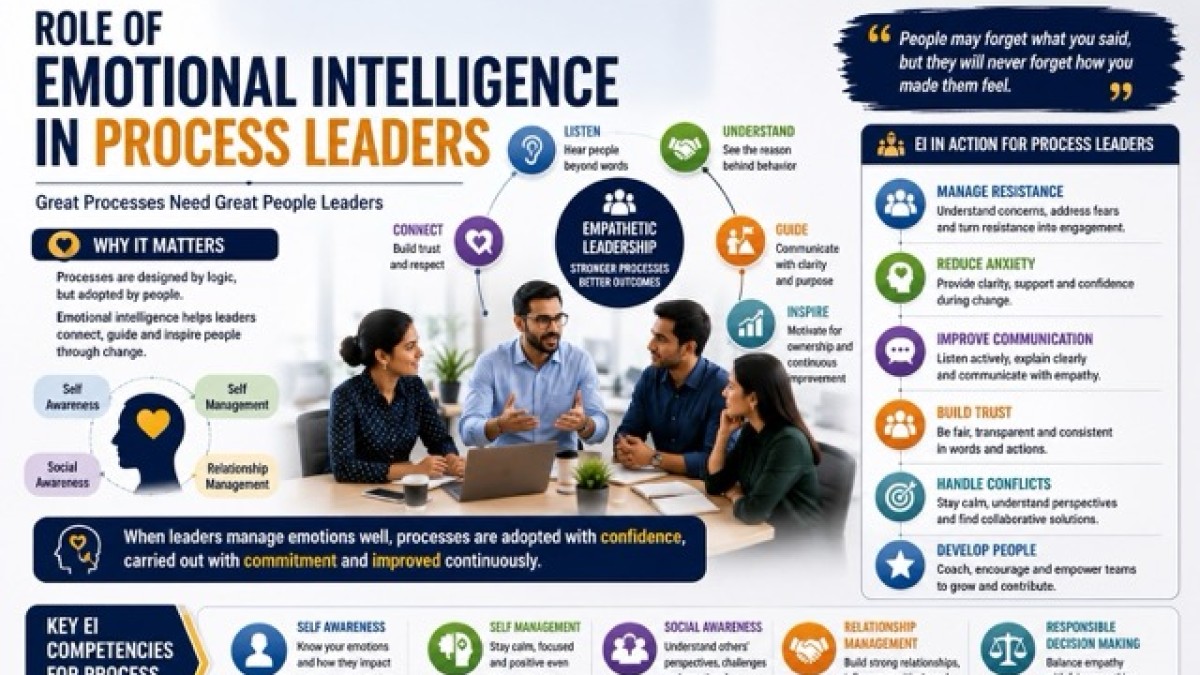
Why emotional intelligence matters for process leaders: managing resistance, reducing change anxiety, resolving conflict and motivating adoption.

Process excellence is often discussed through the language of systems, workflows, SOPs, controls, KPIs, dashboards, audits, and governance. These are necessary. No organization can sustain performance without structure. However, every process is ultimately executed by people. People interpret instructions, adjust to new ways of working, respond to pressure, cooperate with other departments, and either accept or resist change. This is why process leadership is not only a technical responsibility; it is deeply human.
The topic “Role of Emotional Intelligence in Process Leaders” forms part of the people-centered transformation theme in the broader blog series on process and change management. It highlights an important truth: process improvement does not succeed only because the process design is correct. It succeeds when people feel guided, heard, supported, challenged, and accountable.
Emotional intelligence is the ability to understand and manage one’s own emotions while also recognizing and influencing the emotions of others. For process leaders, this capability becomes especially important during SOP implementation, process redesign, system changes, digital transformation, audits, role restructuring, and continuous improvement initiatives. These initiatives often disturb existing comfort zones. They create uncertainty, questions, resistance, fear, conflict, and sometimes fatigue. A technically competent leader may design a good process, but an emotionally intelligent leader helps people adopt it.
Why Emotional Intelligence Matters in Process Leadership
Process leaders work at the intersection of performance and people. Their responsibility is not limited to documenting workflows or monitoring compliance. They must ensure that people understand the process, accept it, follow it, improve it, and sustain it.
In many organizations, process initiatives fail not because the SOP is poorly written, but because the emotional side of implementation is ignored. Employees may think:
- “Will this change increase my workload?”
- “Will my mistakes become visible?”
- “Will automation reduce my importance?”
- “Will my manager blame me if I cannot follow the new process immediately?”
- “Why are we changing something that has worked for years?”
These are not merely operational questions. They are emotional concerns. If leaders dismiss them as negativity, indiscipline, or resistance, they lose trust. If they listen carefully, explain patiently, and respond with fairness, they convert concern into participation.
Emotional intelligence helps leaders balance two important needs: sensitivity and discipline. A process leader must be empathetic, but not weak. Supportive, but not vague. Firm on standards, but respectful in communication. This balance is what makes change sustainablea.
Managing Resistance with Understanding, Not Force
Resistance is one of the most common reactions during process and change initiatives. Employees may resist new SOPs, revised approval systems, digital tools, reporting requirements, audit controls, or performance dashboards. Sometimes resistance is visible through arguments and complaints. At other times, it is silent: delays, excuses, incomplete data, informal workarounds, or passive non-compliance.
A process leader with low emotional intelligence may immediately label such behavior as a discipline problem. The response may be pressure, warnings, escalation, or repeated instructions. While this may produce temporary compliance, it rarely creates ownership.
An emotionally intelligent leader first tries to understand the reason behind resistance. Resistance may arise from lack of awareness, fear of failure, poor training, unclear roles, previous bad experiences, overload, or mistrust of leadership intent. For example, if a sales team resists entering customer data into a CRM system, the real issue may not be laziness. It may be that the system is slow, the fields are confusing, or the team does not understand how the data will help them.
The emotionally intelligent process leader asks practical questions:
- What exactly is difficult for people?
- Which step is unclear? Where are people losing time?
- What fear is not being openly expressed?
- Who needs additional support?
- What must be simplified?
This does not mean accepting all objections. It means diagnosing resistance before treating it. Once the reason is understood, the leader can respond appropriately. If the issue is awareness, communicate the purpose. If the issue is skill, provide training. If the issue is workload, review priorities. If the issue is attitude, address accountability. Emotional intelligence helps the leader choose the right response instead of applying the same pressure to every situation.
Reducing Anxiety During Change
Change creates anxiety because it introduces uncertainty. Even positive changes can make employees uncomfortable. A new ERP system, new SOP, new approval authority, new reporting format, or new performance metric can make people feel exposed. They may worry about making mistakes, losing control, or being judged.
Process leaders must recognize that anxiety is not always irrational. Many employees have experienced poorly implemented changes in the past. They may have seen new systems introduced without training, SOPs released without consultation, or targets changed without resources. As a result, they may become cautious whenever a new initiative begins.
Emotionally intelligent leaders reduce anxiety through clarity. They explain why the change is needed, what will change, what will not change, who will be affected, what support will be provided, and how success will be measured. They do not leave people guessing.
For example, during SOP implementation, anxiety can be reduced by explaining:
- The purpose of the SOP
- The roles and responsibilities
- The step-by-step process
- The expected turnaround times
- The escalation route
- The records to be maintained
- The review mechanism
- The support available during transition
When people know what is expected, anxiety reduces. When leaders are available to answer questions, anxiety reduces further. When early mistakes are treated as learning opportunities rather than occasions for blame, confidence increases.
Emotional intelligence also helps leaders manage their own anxiety. Process leaders are often under pressure from senior management to deliver quick results. If they transfer that pressure directly to employees, the implementation becomes stressful. A self-aware leader recognizes personal frustration and avoids reacting harshly. The leader remains calm, structured, and solution-oriented. This emotional steadiness gives confidence to the team.
Handling Conflict Across Functions
Process initiatives often expose interdepartmental conflicts. Sales may blame operations for delays. Operations may blame procurement for shortages. Procurement may blame finance for payment delays. Finance may blame departments for incomplete documentation. HR may blame managers for poor compliance. IT may blame users for not following system protocols.
A process leader must often work across these boundaries. This requires more than process knowledge. It requires emotional maturity.
Conflict during process improvement is not always bad. In fact, it can reveal real gaps. The problem arises when conflict becomes personal, defensive, or blame-oriented. Emotionally intelligent leaders shift the conversation from “Who is at fault?” to “Where is the process failing?”
For example, if customer orders are delayed, an emotionally intelligent leader does not allow the discussion to become a blame game between sales, production, and dispatch. Instead, the leader maps the flow: order receipt, confirmation, credit approval, production planning, inventory availability, dispatch scheduling, documentation, and customer communication. The conflict is redirected toward process facts.
Such leaders use neutral language. Instead of saying, “Finance is delaying approvals,” they may say, “The approval step currently takes longer than expected because supporting documents are incomplete or not reviewed in time.” This language reduces defensiveness and helps teams solve the issue together.
Emotional intelligence also helps leaders listen to all sides. Often, every department has a partial truth. Sales may be under customer pressure. Operations may be dealing with capacity constraints. Finance may be protecting compliance. IT may be managing system limitations. A process leader must integrate these perspectives into a workable process design.
The best process leaders become facilitators of alignment. They create a safe environment where people can raise concerns without fear, but they also ensure that discussions end with decisions, responsibilities, and timelines.
Building Motivation for Process Adoption
People do not become motivated to follow a process merely because it is documented. Motivation comes when people see meaning, benefit, fairness, and recognition.
An emotionally intelligent process leader connects the process to a larger purpose. Instead of saying, “Follow this SOP because management has approved it,” the leader explains how the process will reduce rework, improve customer response, prevent errors, reduce dependency on individuals, improve coordination, and make work easier over time.
Employees are more likely to adopt a process when they see personal and team-level benefits. For example:
- A clear purchase process reduces follow-up confusion.
- A defined complaint process improves customer trust.
- A structured onboarding process helps new employees settle faster.
- A preventive maintenance process reduces emergency breakdowns.
- A document control process avoids version confusion.
- A performance review process improves fairness and clarity.
Motivation also improves when people are involved. Process leaders should not design processes only in meeting rooms. They should speak to users, understand ground realities, observe actual work, and include employee suggestions. When employees contribute to a process, they feel ownership.
Recognition is another emotional driver. During implementation, leaders should appreciate early adopters, practical suggestions, disciplined record-keeping, cross-functional support, and improvement ideas. Recognition does not always need to be monetary. A simple appreciation in a review meeting can reinforce the right behavior.
Emotionally intelligent leaders understand that motivation is not built by slogans. It is built by respect, involvement, clarity, and visible leadership support.
Balancing Empathy with Accountability
One of the biggest misunderstandings about emotional intelligence is that it means being soft. In reality, emotional intelligence helps leaders hold people accountable in a better way.
Accountability is essential in process management. Without accountability, SOPs become documents, meetings become discussions, and dashboards become reports without action. However, accountability must be applied fairly and constructively.
A low-EQ leader may use fear-based accountability: public criticism, harsh emails, blame, or sudden escalation. This may create compliance on the surface, but it damages trust. People may start hiding problems instead of reporting them.
An emotionally intelligent leader uses transparent accountability. Expectations are clearly defined. Roles are communicated. Deadlines are agreed. Support is provided. Progress is reviewed. Gaps are discussed with facts. Repeated negligence is addressed firmly.
For example, if a department fails to submit weekly process data, the leader should first check whether the format is clear, the data source is available, and the responsible person has been trained. If the issue is genuine, support is provided. If the issue is repeated carelessness, escalation becomes necessary. Emotional intelligence does not avoid difficult conversations; it makes them more effective.
A good accountability conversation may sound like this:
“We agreed that this report would be submitted every Friday. It has been delayed for two consecutive weeks. Is there a process issue preventing timely submission, or is this a discipline gap? Let us identify the reason today and close it.”
This approach is firm, but not insulting. It focuses on the issue, not the person. It gives space for explanation but does not dilute responsibility.
Communication: The Core Skill of Emotionally Intelligent Leaders
Communication: The Core Skill of Emotionally Intelligent Leaders Communication is the bridge between process design and process adoption. Many change initiatives fail because communication is too formal, too late, too technical, or too one-way. Emotionally intelligent process leaders communicate in layers. Senior management may need strategic reasons: cost, control, risk, scalability, compliance, and performance. Middle managers may need clarity on roles, authority, review mechanisms, and resource requirements. Frontline employees may need simple instructions, examples, checklists, and reassurance.
The same message cannot be delivered in the same way to everyone. Emotional intelligence helps leaders adapt communication to the audience.
Good communication during process change should answer five questions:
- Why are we changing?
- What exactly will change?
- How will it affect my work?
- What support will I receive?
- How will success be reviewed?
Leaders should also repeat key messages. One email or one training session is not enough. People absorb change gradually. Communication must happen through meetings, process walkthroughs, FAQs, visual aids, role-based training, review discussions, and feedback sessions.
Listening is equally important. Employees must feel that communication is not just instruction from the top. They should have channels to ask questions, report difficulties, and suggest improvements. Emotionally intelligent leaders treat feedback as process intelligence.
Emotional Intelligence During Process Reviews
Process reviews, audits, and KPI meetings can either build improvement culture or create fear. It depends on how leaders conduct them.
If reviews are used only to identify faults, people become defensive. Data may be manipulated. Problems may be hidden. Teams may focus on justification rather than improvement.
Emotionally intelligent leaders use reviews to learn, correct, and improve. They ask:
- What is working well?
- Where are we facing delays?
- Which step is unclear?
- What support is needed?
- What trend is visible in the data?
- Which corrective action is practical?
- Who will own the next step?
This does not mean poor performance is ignored. It means poor performance is examined constructively. The leader separates error, negligence, system gap, and capability issue. Each requires a different response.
For example, a process failure due to unclear SOP instructions requires revision of the SOP. A failure due to lack of training requires capability building. A failure due to repeated bypassing of controls requires disciplinary accountability. Emotional intelligence helps leaders make these distinctions.
Leading Through Change Fatigue
Organizations often run multiple initiatives at the same time: new SOPs, ERP implementation, cost reduction, audits, restructuring, digital tools, quality improvements, and customer service projects. Employees may become tired of constant change.
Change fatigue shows up as reduced enthusiasm, delayed participation, cynicism, or mechanical compliance. Emotionally intelligent leaders notice these signals early. They do not assume that silence means agreement.
To manage change fatigue, leaders must prioritize. Not every change can be urgent. Teams need sequencing, realistic timelines, and visible management support. Leaders should remove unnecessary complexity, avoid duplicate reporting, and celebrate progress.
They should also be honest. Pretending that change is easy reduces credibility. A better message is: “This change will require effort in the beginning, but it will reduce confusion and rework once stabilized. We will support the team during the transition.”
Such honesty builds trust.
Developing Emotional Intelligence in Process Leaders
Emotional intelligence is not only a personality trait. It can be developed through conscious practice. Process leaders can strengthen it by working on five areas.
- Self-awareness. Leaders must understand their own emotional triggers. Do they become impatient when people question changes? Do they react strongly to delays? Do they avoid conflict? Awareness is the first step toward better leadership behavior.
- Self-regulation. Leaders must manage tone, timing, and reaction. A calm leader helps stabilize a tense process environment.
- Empathy. Leaders must understand the employee experience. This does not mean agreeing with every complaint. It means listening before deciding.
- Relationship management. Process work requires cooperation across functions. Leaders must build trust before they need support.
- Constructive influence. Leaders must inspire people to adopt disciplined ways of working without relying only on authority.
Organizations can support this development through leadership coaching, change management training, feedback mechanisms, cross-functional facilitation exposure, and reflective review practices.
Conclusion
Process excellence is not achieved by documentation alone. SOPs, workflows, KPIs, audits, dashboards, and governance systems are essential, but they become effective only when people adopt them in daily work. This adoption depends heavily on leadership behavior.
Emotionally intelligent process leaders understand that resistance is often a signal, anxiety needs clarity, conflict requires facilitation, motivation needs meaning, and accountability must be firm but fair. They combine discipline with empathy. They listen without losing direction. They support people without diluting standards. They create an environment where process change becomes less threatening and more meaningful.
In the future, organizations will continue to adopt digital tools, automation, analytics, AI, and advanced governance systems. But the human side of process leadership will remain critical. The leaders who succeed will not be those who only know how to design processes. They will be those who know how to help people trust, adopt, improve, and sustain them.
Emotional intelligence, therefore, is not an optional soft skill for process leaders. It is a core leadership capability for successful change, disciplined execution, and sustainable organizational excellence.
Categories: : Governance