Stakeholder Mapping & Influence Strategies That Actually Work
 ACTSol and Associates
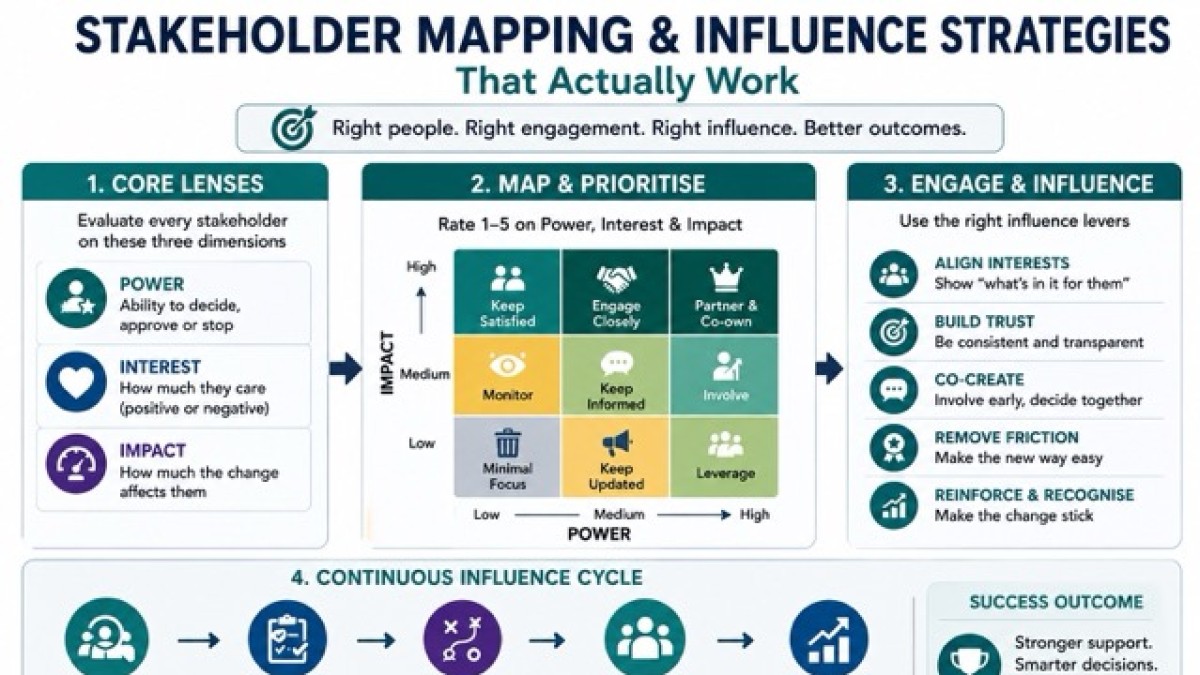
Map stakeholders and influence strategies that actually unblock adoption—not just distribution lists.

Most change programs don’t fail because the solution is wrong. They fail because the people who can block it, ignore it, delay it, “comply without adopting,” or quietly starve it of attention… were treated like a distribution list.
Stakeholder mapping is not a worksheet. It’s a control system.
It tells you who truly shapes outcomes, what they care about, how they will react under pressure, and what it will take to move them from spectator to supporter (or at least from blocker to neutral).
And influence? Influence is not persuasion theatre. Influence is structured, ethical alignment of interests, incentives, identity, and friction; until the “new way” becomes the easy way.
Let’s build a practical, realistic approach you can actually use.
1) the Brutal Reality: Start With Stakeholders Are Not Equal
Some people sign off budgets. Some people control workflows. Some people shape informal norms. Some people can kill adoption with one sentence: “We tried this before.”
Treating everyone the same is the most common stakeholder mistake. So, the goal is not “engage everyone.” The goal is to prioritise precisely, then engage differently.
That means you need three lenses, not one:
- a) Power: Ability to allocate resources, approve, veto, or enforce.
- b) Interest: How much they care (positively or negatively) about the change.
- c) Impact: How much the change affects their work, risk, reputation, targets, or workload.
Power tells you who can decide. Interest tells you who will show up. Impact tells you who will live with it.
Ignore impact, and you get compliance without adoption. Ignore power, and you get adoption without scale. Ignore interest, and you get silence that turns into resistance later.
2) Identify Stakeholders the Way Reality Works
Most teams identify stakeholders from an org chart. That’s the neat version of the organisation. Change happens in the messy version.
Use these five discovery moves to build a complete list:
A. Trace the workflow, not the hierarchy
Follow the actual end-to-end process being changed. Every handoff reveals a stakeholder: user, approver, checker, system owner, dependency owner.
Example: A new digital onboarding process looks “owned by HR. In reality it also touches IT (access), Security (background checks), Finance (payroll setup), Admin (ID cards), and Line Managers (role clarity). Miss one link, onboarding breaks.
B. Find the decision-makers and the “decision shapers”
For every formal decision-maker, there are 1–3 people who shape their decisions:
- a) Chief of staff
- b) Trusted advisor
- c) Business partner
- d) High-performing manager
- e) Long-tenured SME
Example: The CEO approves a new customer service model. But the Head of Operations and a respected regional manager quietly define what is “acceptable.” Influence them, and the CEO’s approval becomes real.
C. Identify the “hidden controllers”
These are not always leaders. They control:
- a) Key data
- b) Approvals
- c) Exceptions
- d) Compliance gates
- e) System configurations
- f) Vendor relationships
Example: In an auto-leasing firm, the credit policy owner may be visible. But the risk analyst team lead who interprets exceptions controls what actually gets approved.
D. Surface informal networks
Ask: “When people are stuck, who do they call?” That’s your informal influencer layer.
Techniques:
- a) Short interviews (15 minutes each)
- b) “Who do you trust?” questions
- c) Meeting observation
- d) Help-desk tickets and escalation patterns
E. Locate “future stakeholders”
Some stakeholders don’t exist yet in your plan:
- a) Auditors who will inspect later
- b) Regulators who may respond to a change
- c) Unions / employee forums
- d) Major customers impacted by service shifts
- e) Vendor partners who must change behaviour
Example: A new field-maintenance scheduling system will be audited for safety compliance later. If HSE isn’t engaged early, you’ll redesign under pressure
3) Segment Stakeholders Using Power, Interest, and Impact (Not Just a 2x2)
The classic Power–Interest grid is useful, but incomplete. Add Impact to stop treating frontline and operational teams as “low priority.” They often have low power but high impact and they determine adoption.
Practical rating method (fast and usable)
Rate each stakeholder (or stakeholder group) on 1–5:
- a) Power: 1 (none) to 5 (can approve/stop)
- b) Interest: 1 (doesn’t care) to 5 (highly invested, positive or negative)
- c) Impact: 1 (barely affected) to 5 (work/life/KPIs heavily affected)
Now classify into segments.
4) The Six Segments That Matter (and What to Do With Each)
Segment 1: Sponsors & Co-Owners
High power + high interest + high impact. These people can scale the change and they will also feel consequences if it fails.
What works
- a) Co-own outcomes, not activities.
- b) Give them a clean decision agenda: what you need them to decide, by when, based on what evidence.
- c) Use dashboards, not slide marathons.
Engagement plan
- a) Weekly / fortnightly sponsor touchpoint (30 minutes)
- b) Monthly governance review (decision gates + risk checkpoints)
- c) “No surprises” brief before any major comms
Communication style
- a) Short, direct, outcome-oriented •Risks framed as “what could derail value”
- b) Options presented with trade-offs (cost/time/risk)
Example: A bank launches a new loan origination workflow. The COO is sponsor and cares deeply about turnaround time.
Instead of asking for “support,” you align on one sponsor KPI: reduce approval time by 20% in 90 days, with quality controls. Sponsor meetings focus only on adoption blockers, exception rates, and branch feedback; so, sponsorship becomes action.
Segment 2: Powerful but Busy
High power + low interest + high impact (or medium impact). They can block you by not showing up. Their default is “Send me a note.”
What works
- a) Make the change relevant to their priorities (risk, cost, reputation, targets).
- b) Use micro-commitments: one decision at a time.
- c) Bring them “pre-solved choices,” not open-ended problems.
Engagement plan
- a) 15-minute check-ins timed to decision moments
- b)One-page decision memos
- c) Escalation path clarified early
Communication style
- a) Executive summaries, not detail
- b) Speak in consequences: “If we don’t decide X by Friday, Y slips by 3 weeks.”
- c) Respect time; build trust through precision
Example: An ERP rollout needs the Head of Sales to standardise discount approvals. Sales doesn’t care about ERP; but cares about deal velocity.
You frame it as: “This removes discount back-and-forth and protects margin leakage.” You ask for one commitment: nominate a sales rep to co-design the approval flow and lock rules by a specific date.
Segment 3: Gatekeepers & Controllers
Medium–high power + medium interest + high impact. They control compliance, risk, systems, data, finance, legal, IT security, QA.. They often look like “obstacles,” but they are usually protecting the organisation.
What works
- a) Early involvement, not late approvals.
- b) Treat them as risk partners, not check-box signatories.
- c) Create shared controls: what must not break, what evidence is required.
Engagement plan
- a) Design workshops focused on controls and exceptions
- b) Pre-approval checkpoints (so approvals are predictable)
- c) Joint sign-off criteria defined upfront
Communication style
- a) Evidence-based, structured, traceable
- b) Show decision logs, audit trails, controls, fallback options
- c) Avoid emotional selling; use risk clarity
Example: A new customer data system triggers privacy concerns. Instead of pushing IT security at the end, you ask: “What are the top 5 non-negotiable controls?” Then design around them: access roles, logs, retention rules, breach response. Gatekeepers become allies because you reduced their anxiety.
Segment 4: Adoption Drivers (Frontline & Middle Managers)
Low–medium power + high interest + high impact. This is where change becomes real or dies.
Frontline teams decide whether the new process is followed. Middle managers decide what is praised, tolerated, or punished.
What works
- a) Co-design “how work will actually happen”
- b) Remove friction (tools, templates, access, training, job aids)
- c) Create visible wins and local champions
- d) Adjust KPIs so old behaviour isn’t rewarded
Engagement plan
- a) Weekly huddles during rollout
- b) Super-user network (peer support)
- c) Feedback loop: issues triaged within 24–48 hours
- d) Recognition for adoption behaviours
Communication style
- a) Practical, specific, respectful
- b) “Here’s what changes Monday morning”
- c) Emphasise benefits in their language: less rework, fewer escalations, clearer approvals
Example: A call centre introduces a new complaint categorisation system. Agents hate it because it feels like extra clicks. You reduce fields, add auto-suggestions, and show how it reduces repeat calls. You train supervisors to coach on “first-call resolution behaviours,” not just volume. Adoption rises because friction fell and support increased.
Segment 5: Quietly Impacted, Quietly Resistant
Low power + low interest + high impact. They don’t attend meetings. They don’t complain loudly. They simply don’t adopt or they create workarounds. These are dangerous because resistance shows up late, in metrics.
What works
- a) Identify their pain early through shadowing and listening sessions
- c) Use “what’s in it for me” that is genuine: time saved, fewer errors, less blame
- d) Provide safe channels to raise concerns (without public confrontation)
Engagement plan
- a) Small group listening sessions
- b) “Day-in-the-life” observations
- c) Anonymous pulse checks during rollout
Communication style
- a) Empathetic, low-pressure, practical
- b) Emphasise support, not compliance threats
- c) Show you will fix issues, not dismiss them
Example: Warehouse staff must use a mobile scanning app. They nod in training but revert to manual logs. A site walk reveals Wi-Fi dead zones and slow devices. Fix infrastructure and simplify steps. Resistance fades because the real problem was friction, not attitude.
Segment 6: Low Priority but Not Zero
Low power + low interest + low impact. Monitor them. Don’t over-invest.
What works
- a) Clear announcements
- b) FAQs and self-serve resources
- c) Point-of-need updates only when relevant Engagement plan
- d) Monthly broadcast updates
- e) Optional office hours
- f) “If you’re impacted, here’s what to do” messaging
Communication style
- a) Informational, light-touch
- b) No over-communication; it creates fatigue
Example: A finance process change affects only certain teams. The rest of the organisation receives a short update and a link to details. No noise. No confusion.
5) Prioritise With a Simple Rule: Focus Where Power Meets Impact
If you want a prioritisation logic that stays sane under pressure, use this:
- High Power + High Impact = must manage actively (Segments 1–3)
- High Impact + Low Power = must enable deeply (Segments 4–5)
- Everything else = monitor
This prevents a common failure: spending 70% of energy on steering committee optics and 30% on the people doing the work. Real change is the opposite.
6) Influence Strategies That Actually Work (No Manipulation, No Theatre)
Influence is not “convincing.” It is reducing the reasons to resist and increasing the reasons to move.
Here are strategies that work across contexts:
1) Trade value, not slogans
Ask: What do they gain, lose, fear, and protect? Then design the change to respect that.
- a) Leaders protect reputation and delivery.
- b) Gatekeepers protect risk and compliance.
- c) Frontline protects time, competence, and fairness.
2) Replace abstract benefits with concrete “Monday morning” improvements
People don’t adopt “transformation.” They adopt simpler approvals, fewer escalations, clearer rules, less rework.
3) Build influence through involvement, not persuasion
If people help design it, they defend it. Even one workshop can convert a critic into a contributor; if it’s real involvement, not staged consultation.
4) Use social proof inside the organisation
Nothing beats: “This worked in Branch X / Site Y / Team Z.” Create early pilots with credible teams, then spread stories, not just metrics.
5) Create micro-commitments
Big commitments trigger fear and delay. Small commitments create motion:
- a) Nominate a representative
- b) Agree to a rule •approve a pilot
- c) Attend a demo •sponsor a recognition moment
6) Reduce friction before you ask for behaviour change
If a new tool is slow, access is blocked, templates are confusing, and support is absent no amount of communication will save adoption.
7) Align metrics and consequences
If old KPIs reward old behaviour, people will keep the old behaviour. Adoption rises when:
- a) KPIs reflect the new process
- b) Supervisors coach the new behaviours
- c) Exceptions are visible and discussed
8) Manage identity threats
Resistance often sounds like “This won’t work.” But the hidden message is: “This makes me look less competent.” Protect competence:
- a) Provide job aids
- b) Allow learning time
- c) Create safe practice environments
- d) Recognise learning, not just performance
9) Turn blockers into risk owners
A strong critic often has valid risk insight. Assign them a role:
- a) “Risk reviewer”
- b) “Control owner”
- c) “Pilot evaluator”
They feel respected. You get smarter. Resistance becomes contribution.
10) Use credibility, not charisma
Influence is earned through:
- a) Listening and fixing
- b) Delivering on promises
- c) Being precise
- d) Being consistent
- e) Escalating fairly
People follow leaders who reduce uncertainty.
7) Engagement Plans by Segment (What You Actually Put in the Plan)
A usable engagement plan answers six questions for each segment:
- Objective: What do we need from them? (Decision, support, adoption, feedback)
- Key message: What will matter to them?
- Channel: How will we reach them? (1:1, workshop, huddle, dashboard, demo)
- Cadence: How often and when? (tied to milestones)
- Owner: Who will manage the relationship? (named person, not “project team”)
- Success signals: What will we measure? (attendance, decisions, adoption metrics, sentiment)
Example: CRM rollout stakeholder plan (simplified)
- a) Sponsor (Sales Director): approve sales stages + enforce usage in pipeline reviews; weekly dashboard.
- b) Gatekeeper (IT Security): agree access roles + audit logs; control workshop + sign-off checklist.
- c) Adoption drivers (Team Leads): coach behaviours; weekly huddles + issue triage in 48 hours.
- d) Quietly impacted (Field reps): reduce admin time; ride-along + quick fixes + job aids.
This is practical. It’s not a poster.
8) Communication Styles That Fit Each Segment
Communication fails when tone is wrong. Not “wrong language.” Wrong psychology. Here’s the simple alignment:
- a) Sponsors & Powerful Stakeholders want: clarity, options, risks, outcomes.
- b) Gatekeepers want: evidence, controls, traceability, risk mitigation.
- c) Frontline wants: practicality, support, fairness, reduced friction.
- d) Quietly impacted wants: safety to speak, respect, visible fixes.
- e) Low priority wants: clean updates, minimal noise.
If you speak “vision” to gatekeepers, they don’t trust you. If you speak “policy” to frontline, they disengage. If you speak “details” to executives, they disappear. Match the message to the mind.
9) Realistic Scenarios: How Influence Plays Out
Scenario A: Middle manager resistance in a service redesign
A new service process requires supervisors to do coaching and quality reviews. They resist: “We don’t have bandwidth.”
What actually works:
- a) Show how escalations reduce when coaching happens
- b) Remove two low-value reports to free time
- c) Change supervisor KPIs to include quality and repeat complaints
- d) Create a peer group for supervisors to share fixes
Influence was not persuasion. It was work redesign + metric alignment.
Scenario B: A powerful stakeholder doesn’t care
A CFO is not interested in a workflow change. But the change affects cashflow predictability.
What works:
- a) One-page memo: impact on DSO, error leakage, audit risk
- b) Ask for one decision: approve the rule set and escalation path
- c) Give monthly dashboard snapshots only
Influence was relevance + low-friction engagement.
Scenario C: Frontline silent non-adoption
A new digital checklist is introduced for site operations. Training is done. Adoption is low.
What works:
- a) Shadowing reveals checklist is too long and app is slow
- b) Simplify checklist to “critical controls”
- fix access and connectivity
- c) Create daily 10-minute huddles for first 3 weeks
- d) Recognise early adopters
Influence was friction removal + support + reinforcement.
10) A Simple Stakeholder Influence Playbook You Can Reuse
If you want one repeatable approach, run this loop:
- Map stakeholders by power, interest, impact
- Prioritise by power–impact intersections
- Diagnose motives: gains, losses, fears, protections
- Design segment-specific engagement plans
- Execute with micro-commitments and feedback loops
- Measure adoption + sentiment + decision velocity
- Adjust quickly: fix friction, update comms, reassign owners
Stakeholder strategy is not a one-time deliverable. It is a living operating rhythm.
Closing Insight: Influence is a System, Not a Speech
If your stakeholder strategy depends on charisma, it will collapse when you’re not in the room.
If your stakeholder strategy is built on:
- a) Clear segmentation (power, interest, impact)
- b) Tailored engagement (right cadence, right channel, right owner)
- c) Practical communication (message matched to psychology)
- d) Friction removal (tools, support, incentives)
- e) Visible reinforcement (metrics, recognition, coaching)
…then adoption becomes predictable. And that is the real point.
Change is not won by announcing it. Change is won by engineering alignment, stakeholder by stakeholder, until the new behaviour becomes the default behaviour.
Categories: : Governance