Sustainability-Driven Process Excellence
 ACTSol and Associates
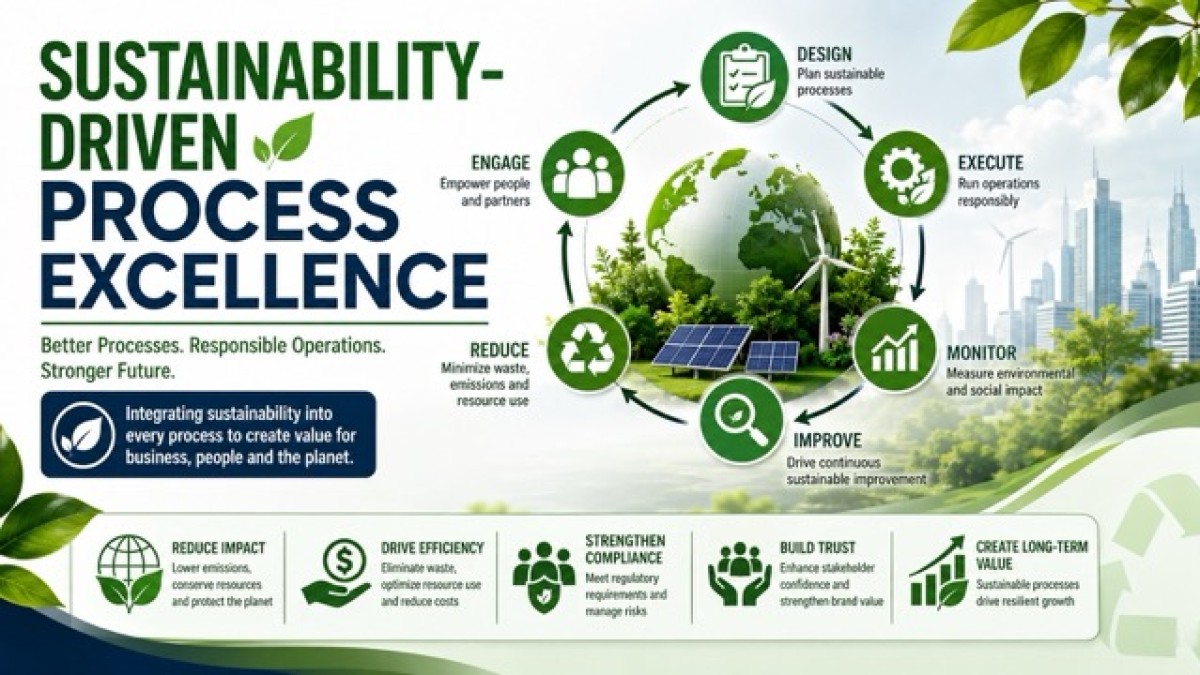
How process excellence drives sustainability: waste reduction, resource optimization, ESG goals, compliance, energy discipline, SOPs, and KPIs.

Sustainability is no longer a separate corporate initiative handled only by environment, health and safety teams, CSR departments, or annual reporting teams. It has become a core business requirement. Customers, investors, regulators, employees, and communities are increasingly asking one important question: How responsibly does the organization operate? This is where process excellence plays a powerful role.
Process excellence has traditionally focused on improving quality, reducing waste, increasing speed, improving productivity, strengthening controls, and creating standard ways of working. Sustainability-driven process excellence takes this thinking further. It asks organizations to design, run, monitor, and improve processes in a way that reduces environmental impact, optimizes resources, supports ESG goals, ensures compliance, and promotes responsible operations.
In the broader blog series framework on “Excellence in Process & Change Management,” Sustainability-Driven Process Excellence is positioned as part of the future-facing themes of process and organizational change. The framework places it under the cluster focused on adapting processes and practices to emerging work models and future business expectations.
What Is Sustainability-Driven Process Excellence?
Sustainability-driven process excellence means improving business processes not only for cost, quality, speed, and customer satisfaction, but also for environmental and social responsibility. It integrates sustainability into the way work is planned, executed, measured, and governed.
For example, a procurement process should not only focus on price and delivery. It should also evaluate supplier compliance, ethical sourcing, packaging practices, transportation footprint, and responsible material usage. A production process should not only focus on output and rejection rates. It should also monitor energy consumption, water usage, scrap generation, emissions, rework, and safe operating practices.
In simple terms, sustainability-driven process excellence changes the question from:
“How do we do this process faster and cheaper?”
to:
“How do we do this process better, responsibly, efficiently, and sustainably?”
This shift is important because many sustainability issues are actually process issues. Excess inventory, high rejection, poor planning, rework, unnecessary approvals, inefficient transportation, paper-heavy documentation, avoidable energy consumption, and weak compliance tracking are all examples of process weaknesses that create environmental, financial, and operational waste.
How Process Excellence Supports Sustainability
Process excellence supports sustainability by making operations more disciplined, measurable, and improvement-oriented. Sustainability goals often fail when they remain high-level statements without practical process ownership. Organizations may declare ESG targets, but unless those targets are translated into operating procedures, KPIs, audits, responsibilities, and review mechanisms, they remain disconnected from daily work.
Process excellence closes this gap.
It converts sustainability into daily operating discipline. It defines who does what, how resources are used, how deviations are reported, how risks are controlled, how waste is reduced, and how performance is reviewed. In this way, sustainability becomes part of routine work rather than an additional burden.
For example, if an organization wants to reduce electricity consumption, it must go beyond awareness posters. It needs equipment shutdown procedures, preventive maintenance schedules, energy monitoring dashboards, responsibilities for shift supervisors, escalation rules for abnormal consumption, and periodic review by management. This is process excellence in action.
Similarly, if a company wants to reduce paper usage, it must redesign approval workflows, digitize records, define document retention rules, create e-signature controls, train users, and monitor adoption. Without process discipline, sustainability initiatives become campaigns. With process excellence, they become systems.
Waste Reduction: The Common Link Between Lean and Sustainability
Waste reduction is one of the strongest connections between process excellence and sustainability. Lean thinking already teaches organizations to identify and eliminate waste. Sustainability adds another dimension by looking at how waste affects natural resources, energy, emissions, and responsible operations.
In many organizations, waste is visible in different forms. There may be material wastage due to poor handling, quality defects, excess consumption, expired inventory, unnecessary packaging, or wrong specifications. There may be time wastage due to unclear approvals, repeated follow-ups, manual data entry, and poor coordination. There may be energy wastage due to idle machines, air leakages, inefficient lighting, poor maintenance, and lack of monitoring. There may also be information wastage due to duplicate reports, uncontrolled documents, and poor data quality.
Each of these wastes has a cost. But each also has a sustainability impact.
A rejected product does not only mean financial loss. It also means wasted raw material, wasted power, wasted manpower, wasted machine time, wasted packaging, and possibly additional disposal burden. Rework does not only delay delivery. It consumes extra energy, extra inspection effort, and extra production capacity. Poor planning does not only create operational stress. It may lead to emergency transport, excess fuel consumption, and inefficient logistics.
Therefore, sustainability-driven process excellence encourages teams to look at waste more holistically. It asks them to identify the operational reason behind waste and then redesign the process to prevent recurrence.
Resource Optimization: Doing More With Less, Responsibly
Resource optimization is not about blindly cutting costs. It is about using resources intelligently, responsibly, and effectively. Every organization depends on resources such as people, materials, machines, energy, water, space, time, technology, and capital. Poor processes misuse these resources. Strong processes protect them.
For example, a poorly designed maintenance process may lead to frequent equipment breakdowns, excess spare consumption, high energy use, safety risks, and production loss. A well-designed maintenance process ensures inspection, lubrication, calibration, preventive replacement, monitoring, and accountability. This improves equipment life and reduces avoidable consumption.
Similarly, a weak inventory process may result in overstocking, expiry, damage, duplicate purchases, and blocked working capital. A strong inventory process ensures demand planning, minimum and maximum stock levels, FIFO or FEFO controls, stock audits, storage discipline, and slow-moving item review. This improves both financial performance and sustainability.
Resource optimization also applies to people. When employees are forced to work with unclear processes, repeated corrections, unplanned firefighting, and manual duplication, their time and energy are wasted. Sustainable organizations must also reduce human process fatigue. Clear SOPs, role clarity, automation, training, and practical workflows help employees work better with less frustration.
Sustainability is therefore not limited to environmental conservation. It is also about building processes that are economically viable, operationally stable, socially responsible, and human-friendly.
ESG Goals and Process Excellence
ESG stands for Environmental, Social, and Governance. Many organizations now define ESG goals at the corporate level. These may include reducing emissions, improving energy efficiency, strengthening diversity and inclusion, improving safety, ensuring ethical sourcing, reducing waste, improving transparency, and strengthening governance.
However, ESG success depends heavily on process maturity.
Environmental goals require processes for energy management, waste management, water conservation, pollution control, material optimization, and environmental compliance. Social goals require processes for employee safety, welfare, training, grievance handling, fair labour practices, community engagement, and responsible customer practices. Governance goals require processes for approvals, documentation, audits, risk management, ethical conduct, statutory compliance, reporting, and accountability.
If these processes are weak, ESG reporting becomes difficult and unreliable. Data may be scattered, ownership may be unclear, and corrective actions may not be tracked. This creates reputational, regulatory, and operational risks.
For ESG goals to be meaningful, organizations must translate them into process-level controls. Each major ESG objective should be supported by SOPs, checklists, responsible owners, measurable KPIs, review frequency, evidence requirements, and escalation mechanisms. This ensures that ESG is not treated only as a reporting activity but as an operating discipline.
Compliance as a Process, Not an Event
Compliance is often treated as a periodic activity: prepare documents before an audit, respond to regulatory notices, submit reports, or close observations after inspection. But sustainability-driven process excellence treats compliance as an ongoing process.
This is especially important in areas such as environmental regulations, safety standards, labour laws, statutory reporting, waste disposal rules, emissions norms, data governance, and supplier compliance. Non-compliance can result in penalties, shutdowns, customer dissatisfaction, reputational damage, and loss of trust.
A mature compliance process clearly defines applicable requirements, responsible persons, due dates, records to be maintained, approval mechanisms, reporting formats, review frequency, and escalation rules. It also includes internal audits and compliance dashboards.
For example, hazardous waste disposal should not depend on memory or individual follow-up. It should have a defined process covering waste identification, segregation, storage, labelling, vendor authorization, transport documentation, disposal certificates, record retention, and periodic review. Similarly, energy or emissions data should not be collected only at year-end. It should be captured regularly, validated, reviewed, and acted upon.
Compliance becomes stronger when it is built into the workflow. The best processes do not wait for violations to occur. They prevent violations through design, training, monitoring, and accountability.
Energy Use and Process Discipline
Energy is one of the most important areas where process excellence can directly support sustainability. In many organizations, energy consumption is treated as a utility cost rather than a process performance indicator. But energy usage is deeply connected to process design, equipment condition, production planning, maintenance discipline, operator behaviour, and monitoring practices.
A process excellence approach to energy management starts by understanding where, when, and why energy is consumed. It may involve mapping energy-intensive processes, identifying idle running, measuring machine-wise consumption, reviewing compressed air systems, improving preventive maintenance, optimizing heating and cooling systems, and training employees on energy-efficient operations.
Energy-saving opportunities often lie in small process improvements. Switching off idle equipment, reducing compressed air leakages, optimizing batch sizes, improving insulation, maintaining motors and pumps, using sensors, and reducing rework can all contribute to lower energy consumption.
But these improvements become sustainable only when they are standardized. A one-time energy-saving campaign may create temporary improvement. A documented and monitored energy management process creates long-term discipline.
Organizations can also include energy KPIs in process reviews. For example, energy consumption per unit produced, power consumption by department, idle running hours, peak load variation, and maintenance-related energy losses can be tracked. When energy becomes visible in dashboards, teams begin to manage it actively.
Responsible Operations: Beyond Efficiency
Responsible operations mean that the organization does not focus only on output, revenue, and profit. It also considers safety, ethics, environment, community impact, employee well-being, customer trust, and long-term business resilience.
Process excellence supports responsible operations by reducing ambiguity. It defines acceptable ways of working and creates control points where risks can be identified and corrected.
For example, responsible operations in procurement may include supplier due diligence, conflict-of-interest declaration, ethical sourcing checks, compliance documentation, quality validation, and approval controls. Responsible operations in manufacturing may include safe work instructions, machine guarding, pollution control, waste segregation, process monitoring, and emergency response procedures. Responsible operations in sales may include fair commitments, accurate product information, responsible customer communication, and complaint handling.
In every function, responsible operations require a combination of policy, process, training, monitoring, and leadership commitment. Employees must know what is expected. Managers must review compliance. Leaders must demonstrate seriousness. Deviations must be corrected. Good practices must be recognized.
Role of SOPs in Sustainability-Driven Excellence
SOPs are one of the most practical tools for embedding sustainability into everyday work. A well-written SOP can include sustainability checkpoints in the process itself. These checkpoints may relate to resource use, waste control, energy saving, safety, compliance, documentation, and escalation.
For example, a production SOP can include instructions for minimizing material loss, handling scrap, reporting abnormal energy consumption, preventing contamination, and recording rejection reasons. A purchase SOP can include supplier sustainability criteria, packaging expectations, compliance documents, and preference for approved responsible vendors. A logistics SOP can include route optimization, vehicle utilization, shipment consolidation, and transport documentation.
The key is not to create separate sustainability documents that nobody uses. The better approach is to integrate sustainability into existing operational SOPs. This makes sustainability practical, visible, and auditable.
Measuring Sustainability Through Process KPIs
What gets measured gets managed. Sustainability-driven process excellence requires meaningful KPIs that connect operations with sustainability outcomes.
Some examples include:
- Material wastage percentage
- Rejection rate
- Rework hours
- Scrap generation
- Energy consumption per unit
- Water consumption
- Paper usage
- Waste disposal compliance
- Supplier compliance score
- Audit observations
- Safety incidents
- Corrective action closure time
- Process deviation frequency
However, organizations must avoid overloading teams with too many indicators. The purpose of KPIs is to guide action, not create reporting burden. Each KPI should have a clear owner, data source, review frequency, target, and corrective action mechanism.
Dashboards can make sustainability performance visible. For example, a monthly operations review can include not only production, quality, and cost metrics but also energy, waste, safety, compliance, and improvement actions. This helps leadership connect sustainability with business performance.
Leadership and Culture
Sustainability-driven process excellence cannot succeed through documentation alone. It requires leadership commitment and cultural change. Leaders must communicate that responsible operations are not optional. They must include sustainability in reviews, decisions, investments, training, and recognition.
Employees should also be encouraged to identify improvement opportunities. Often, people working closest to the process know where waste occurs. Operators, supervisors, warehouse staff, maintenance teams, procurement executives, and customer service teams can provide practical ideas for reducing waste and improving responsibility.
A culture of sustainability grows when small improvements are valued. If employees see that their suggestions lead to real changes, they become active participants. Recognition, communication, audits, and feedback loops help reinforce the desired behaviour.
Conclusion
Sustainability-driven process excellence is the next natural evolution of process improvement. It combines operational discipline with environmental and social responsibility. It helps organizations reduce waste, optimize resources, manage energy, meet ESG goals, strengthen compliance, and build responsible operations.
The most important point is that sustainability should not remain a slogan, report, or leadership presentation. It must enter the daily process. It must be reflected in SOPs, KPIs, audits, roles, reviews, dashboards, training, and corrective actions.
Organizations that integrate sustainability with process excellence will not only become more compliant and responsible. They will also become more efficient, resilient, trusted, and future-ready. In a world where stakeholders increasingly expect responsible business conduct, the best organizations will be those that can prove sustainability through the way they work every day.