The Mindset of an Effective Change Leader
 ACTSol and Associates
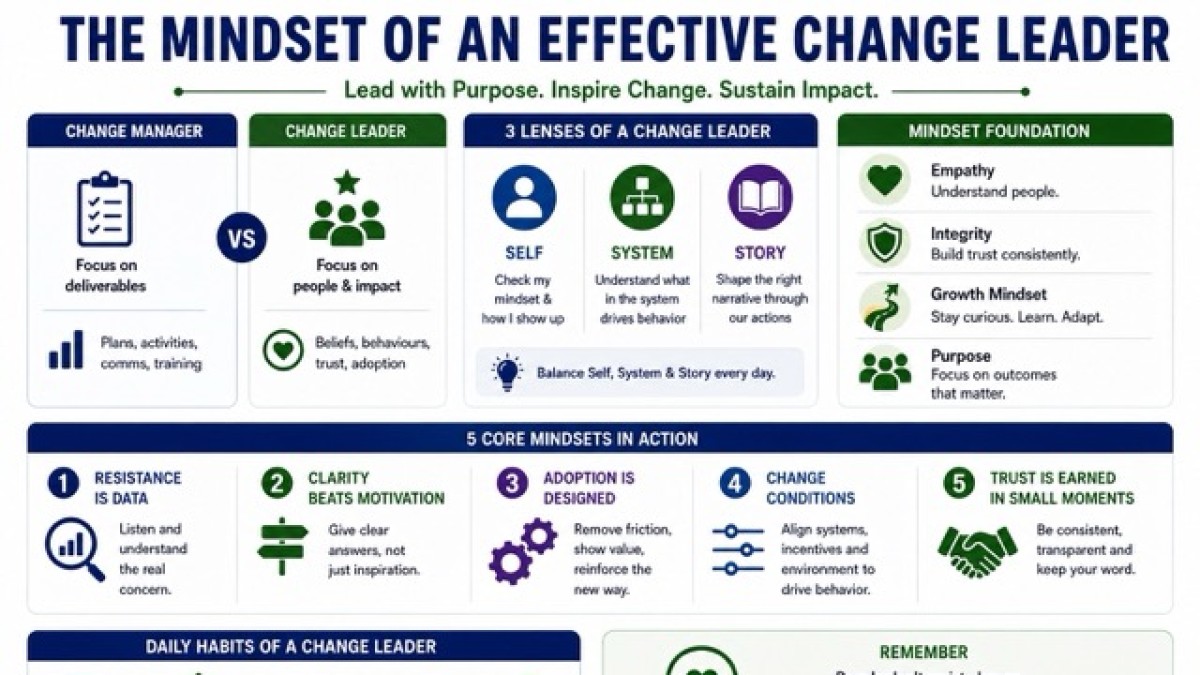
Change fails in interpretation—build the mindset that turns plans into adopted, lasting change.

Most change programs don't fail in planning. They fail in interpretation.
People interpret a change as: "This is extra work." Or "This is a threat." Or "This will disappear in six months, like the last one." And the moment that meaning is set, you are no longer managing a project. You are leading a human transition.
That's the difference between an average change manager and a true change leader.
- An average change manager focuses on deliverables: comms, training, trackers, readiness scores.
- A change leader focuses on beliefs and behaviours: ownership, trust, capability, habit formation, and the emotional reality of loss and uncertainty.
A change leader still uses plans, governance, and comms. But they don't worship the plan. They work the psychology.
This article breaks down the mindset into three layers; beliefs, habits, and emotional skills with examples, reflection questions, and simple daily practices you can actually do.
Change Manager vs Change Leader: The Real Split
Here's a blunt truth: you can "execute change management" and still fail to create change.
Because you can ship:
- A communication plan that no one believes,
- Training that nobody applies,
- And a go-live that everyone survives… while adoption quietly collapses.
A change manager asks: "Did we deliver the change activities?"
A change leader asks: "Did people genuinely switch their behaviour when it matters?"
A change leader treats adoption like a product:
- Users (employees) have friction,
- Value must be experienced quickly,
- Feedback loops must be real,
- And trust is the currency.
The Three Lenses of a Change Leader
Effective change leaders operate through three lenses, every day:
- Self: What am I projecting right now certainty, anxiety, impatience, ego?
- System: What in the structure is driving behaviour KPIs, approvals, incentives, constraints?
- Story: What meaning are people making and what story are we reinforcing through our actions?
Average change managers live in "System" (process, plans). Change leaders integrate all three.
Part 1: The Beliefs That Separate Average from Excellent
1) "Resistance is data, not defiance."
Average response: "They're resisting. Escalate."
Change leader response: "What is this resistance telling us about risk, identity, workload, or trust?"
Example: In an ERP rollout, store teams keep using Excel trackers. The change manager pushes compliance: "Stop using spreadsheets."
The change leader investigates: "Which ERP screens are slower? What approvals are missing? Are they afraid of being blamed for errors?"
Result: fix workflow bottlenecks, simplify fields, and create a "safe sandbox" for practice. Adoption improves because friction drops and fear reduces.
Reflection questions
- What "resistance" have I labelled too quickly?
- If this resistance is rational, what is it protecting?
Daily practice (2 minutes)
Replace the sentence "They are resisting" with: "They are protecting something." Then write what that "something" might be.
2) "Clarity beats motivation."
Average response: big speeches, inspiring slogans.
Change leader response: "Confusion creates delay. Delay becomes scepticism."
People don't need hype. They need:
- What's changing,
- Why it matters,
- What stays the same,
- What they must do differently,
- And how success will be measured.
Example: A new remote work policy triggers anxiety. Leaders talk about "flexibility" but won't define expectations. Employees panic and managers improvise rules.
A change leader publishes a one-page "operating agreement": response times, meeting norms, performance outcomes, escalation paths. Anxiety drops because ambiguity drops.
Reflection questions
- Where are we asking people to "figure it out"?
- What's the single most confusing part of this change?
Daily practice (5 minutes)
Write a plain-English "So what?" note: "Starting Monday, for you, this means…" (3 bullets)
3) "Adoption is designed, not demanded."
Average response: mandate, enforce, chase.
Change leader response: design the environment so the new behaviour becomes the easiest behaviour.
Adoption happens when:
- Friction is low,
- Benefits are visible,
- Support is available,
- And the new way is reinforced by the system.
Example: A safety process in a construction project requires daily checklists. People skip it because it's hard to access and time-consuming.
A change leader: QR code at the site entry, mobile-friendly checklist, supervisor coaching, and recognition for compliance. Compliance rises without shouting.
Reflection questions
- What part of the change is "harder than it needs to be"?
- What friction could we remove this week?
Daily practice (3 minutes)
Ask: "What is one click, one step, one approval we can remove?"
4) "You don't change people. You change conditions."
People behave according to:
- Incentives,
- Social norms,
- Tools,
- Time pressures,
- And what leadership actually rewards.
Example: A customer service team is told to use a CRM properly, but their KPI still rewards call volume over case quality. A change leader aligns KPIs and recognition to CRM behaviour. The system starts "pulling" the change.
Reflection questions
- Which metric is silently sabotaging our message?
- What do people get rewarded for today?
Daily practice (2 minutes)
Identify one misalignment: "We say X, but we reward Y."
5) "Trust is a deliverable."
Trust is built when leaders are:
- Consistent,
- Transparent about trade-offs,
- Willing to say, "I don't know yet,"
- And quick to close feedback loops.
Example: During a merger, leaders promise "no changes," then quietly restructure teams. A change leader sets a better standard: "Here's what we know, here's what we don't, here's when we'll update you." Trust rises because honesty replaces theatre.
Reflection questions
- Where have we over-promised to keep people calm?
- What truth are we avoiding that employees already suspect?
Daily practice (1 minute)
Add this sentence to your updates: "Here's what we're still figuring out."
Part 2: The Habits of an Effective Change Leader
Beliefs shape behaviour. Habits make it repeatable.
They obsess over the "first 2 weeks" experience.
Average change managers plan for go-live day. Change leaders plan for the first two weeks after go-live; when confusion peaks and habits form.
Example: An AI copilot is launched. People try it once, get a mediocre answer, and stop.
A change leader sets "guided wins": sample prompts, use-cases by role, office hours, and peer sharing. Usage sticks because early success is engineered.
Reflection questions
- What will employees experience in their first 10 uses of the new tool/process?
- Where will they get stuck?
Daily practice (5 minutes)
Write a "Day 1, Day 3, Day 10" support plan: what help exists at each point?
7) They run tight feedback loops (and close them).
Feedback without visible action becomes cynicism. Change leaders make feedback actionable and publicly responded to.
Example: In a CRM program, employees submit issues but hear nothing back. They stop engaging. A change leader publishes a weekly "You said / We did" note with fixes, decisions, and rationale.
Reflection questions
- Are we collecting feedback… or converting it into improvements?
- What is the average time to respond to feedback?
Daily practice (3 minutes)
End meetings with: "What's one friction we can remove by Friday?"
8) They build champions as "listeners," not loudspeakers.
Average approach: champions are message repeaters.
Leader approach: champions are sense-makers; they listen, surface local truths, and co-design adoption.
Example: A global policy is rolled out to multiple sites. Local champions report "this clashes with shift patterns." Change leader adapts implementation while keeping policy intent intact. Adoption improves without breaking governance.
Reflection questions
- Are champions empowered to change implementation, or only broadcast?
- Do we treat local reality as intelligence or nuisance?
Daily practice (2 minutes)
Ask one champion: "What are people saying when I'm not in the room?"
9) They make decisions at the right altitude.
Change leaders know when to:
- Zoom out for principles,
- Zoom in for specific behaviours.
Average change managers drown in detail or float in slogans. Leaders translate strategy into "Monday morning behaviour."
Example: "Be customer-centric" becomes: "Use the new case categorization before escalation; log resolution notes within 2 hours."
Reflection questions
- What is the behaviour version of our strategy?
- What are we asking people to do on a Tuesday afternoon?
Daily practice (4 minutes)
Convert one abstract message into three observable behaviours.
10) They protect attention like a scarce resource.
Change overload kills adoption. Leaders simplify, sequence, and create whitespace.
Example: An organization launches ERP, new appraisal process, and cost controls simultaneously. Employees give up.
A change leader negotiates sequencing: "ERP first, appraisal next quarter." Not perfect realistic.
Reflection questions
- What change are we layering on top of an already full system?
- What can we pause to protect adoption?
Daily practice (2 minutes)
Ask: "What are we stopping so this can start?"
Part 3: Emotional Skills That Make Change Leadership Work
Change is emotional because work is identity:
- Competence,
- Status,
- Safety,
- Belonging.
You can't out-slide human emotion.
11) Emotional self-awareness: "What am I bringing into the room?"
Leaders transmit emotion faster than they transmit information. If you are anxious, defensive, or rushed, people feel it.
Example: A leader enters a town hall irritated by delays. The room becomes guarded.
A change leader enters grounded: calm tone, clear boundaries, honest uncertainty. The room stays open.
Reflection questions
- When I'm stressed, what do I become controlling, dismissive, silent?
- What emotion do people feel after talking to me?
Daily practice (60 seconds)
Before a key interaction: Name your state. "I'm tense." → Take 3 slow breaths → "I choose calm clarity."
12) Emotional regulation: "Hold steady when others wobble."
When people fear loss, they test leadership stability. If you overreact, you become the problem.
Example: During a restructuring, rumours spread. A change leader does not lash out. They calmly repeat facts, timelines, and listening channels and address misinformation without humiliation.
Reflection questions
- What triggers my defensiveness during change?
- How do I respond when someone challenges the change publicly?
Daily practice (2 minutes)
Use the pause: Stop → Breathe → Ask a question → Respond.
13) Empathy without weakness: "Validate feelings, not fantasies."
Empathy is not agreement. It is accurate understanding.
Example: An employee says, "This new system will make my role useless."
Average response: "No, it won't." (dismissive)
Change leader response: "I hear the fear. Let's talk about what changes, what stays, and what skills we'll build."
Reflection questions
- Do I correct emotions instead of acknowledging them?
- What fear is underneath the complaint?
Daily practice (1 minute)
Use: "That makes sense given what you're seeing."
14) Courage: "Have the hard conversations early."
Change leaders don't delay conflict. They surface it cleanly.
Example: A senior manager quietly undermines a new policy.
A change leader meets them early: clarifies expectations, names the behaviour, offers support, and sets consequences if sabotage continues.
Reflection questions
- Which conversation am I postponing that is costing adoption?
- What boundary must be stated clearly?
Daily practice (3 minutes)
Write the opening line for the hard conversation. Then schedule it.
15) Humility: "I might be wrong."
Change leaders learn publicly. They don't protect ego; they protect outcomes.
Example: A training approach isn't working. A change leader says: "We designed this wrong. We're changing it." That honesty builds credibility faster than pretending.
Reflection questions
- Where am I attached to my plan rather than the outcome?
- What would I change if I wasn't trying to look consistent?
Daily practice (2 minutes)
Ask: "What's one thing we should stop doing in this change plan?"
16) Resilience: "Play the long game without going cold."
Change is repetition. You will explain the same thing 30 times. You will face setbacks. Resilience keeps you warm, not weary.
Example: Adoption dips after go-live. Average manager panics and blames. Change leader stabilizes, learns, adjusts supports, and celebrates progress without denying gaps.
Reflection questions
- Do setbacks make me harsh or curious?
- What is "good progress" for this week (not perfection)?
Daily practice (5 minutes)
End the day with: Win / Stuck / Next step (one line each).
A Simple Daily Operating System for Change Leaders
You don't build mindset by reading. You build it by repetition.
Here's a practical routine that takes 15 minutes total.
Morning (5 minutes): Set your leadership intention
- What's the most important behaviour we need today?
- 2 Where will friction show up?
- How will I reduce uncertainty for someone today?
During the day (3 micro-moments, 2 minutes each)
- Before a meeting: "What emotion is in the room and what do they need from me?"
- After a complaint: "What is this protecting?"
- Before sending a comms: "Is this clarity or corporate poetry?"
Evening (4 minutes): Close loops
- What feedback did I hear today?
- What action will I take or what decision will I communicate?
- Who needs a direct follow-up to sustain trust?
Weekly (20 minutes): The adoption reality check
- What are the top 3 adoption barriers?
- What did we fix last week?
- Who is slipping, and why?
- What support will we add, remove, or simplify?
Reflection Questions to Build the Mindset (Use These in Journaling or Team Reviews)
About beliefs
- Where am I treating adoption as compliance instead of design?
- What story is the organization telling itself about this change?
About habits
- Are we closing feedback loops visibly and quickly?
- Are we supporting the "first two weeks" experience properly?
About emotional skills
- When I feel pressure, do I become clearer or noisier?
- Do people feel safe telling me bad news?
About leadership impact
- If this change fails, what will the post-mortem say we ignored?
- What is one small win we can deliver in 7 days that proves value?
Closing Insight: The Mindset Is the Method
The mindset of an effective change leader is not positivity.
It is precision:
- Precision about human behaviour,
- Precision about systems that drive choices,
- And precision about the emotional weight of uncertainty.
Average change managers execute activities.
True change leaders change conditions, shape meaning, build trust, and make new behaviours easier than old ones.
If you want one sentence to carry into tomorrow, make it this: "My job isn't to launch the change. My job is to make the new way feel clear, safe, valuable, and doable; until it becomes normal."
Categories: : Leadership