Why Change Fails: Beyond Buzzwords
 ACTSol and Associates
This article strips away the buzzwords and examines why change actually fails, not at the surface level, but at the structural and behavioural core.
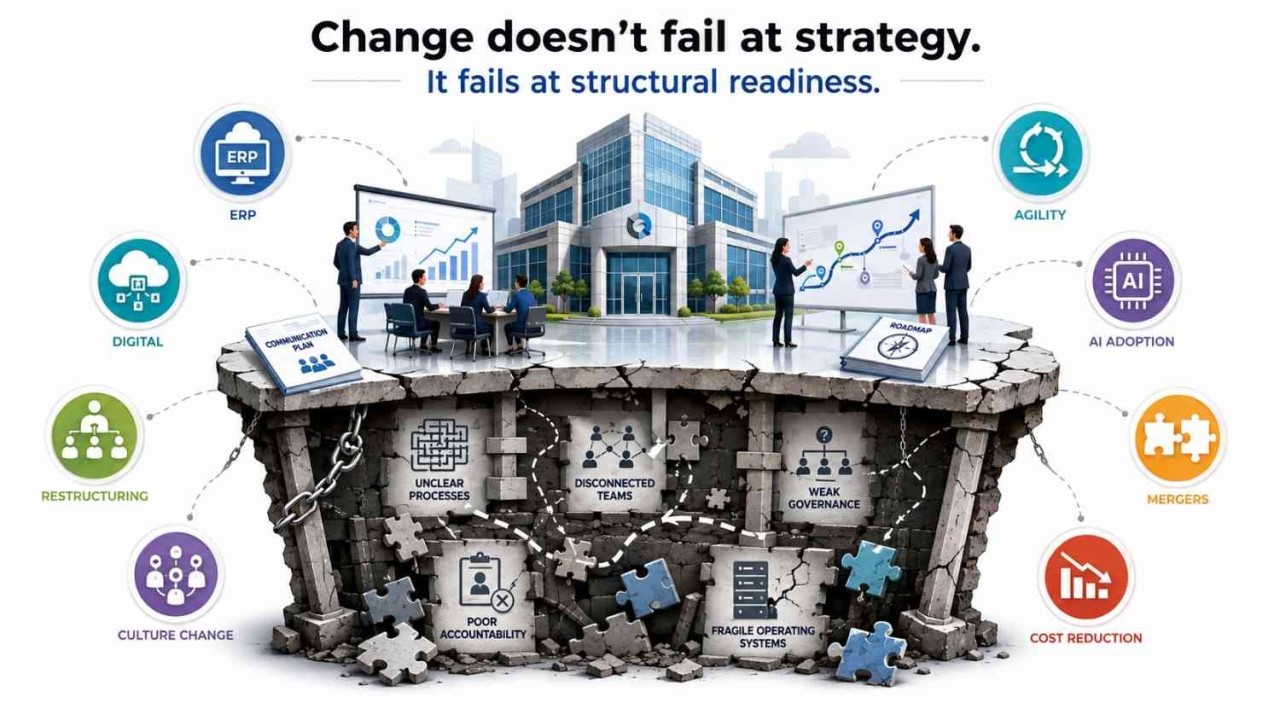
That may sound uncomfortable. It should.
Every year, organisations invest millions in transformation programs, ERP rollouts, digital initiatives, restructuring efforts, culture change agendas, agility programs, AI adoption, mergers, and cost-reduction drives. PowerPoint decks are polished. Communication plans are launched. Leaders speak confidently about “the journey.”
And yet, quietly, predictably, painfully, the change fizzles out. Not immediately. It dies slowly. Adoption drops. Old behaviours resurface. Shadow processes reappear. The system technically goes live, but people work around it. Leaders move on to the next priority.
Six months later, no one talks about the change anymore, except to explain why it “didn’t quite work here.” The most dangerous part? Everyone walks away believing the wrong lesson. “Our people resist change.” “This organisation isn’t mature enough.” “The culture isn’t ready.” “Execution was the problem.”
These are lazy explanations. And they prevent organisations from ever fixing the real issues. This article strips away the buzzwords and examines why change actually fails, not at the surface level, but at the structural and behavioural core.
The “People Resist Change” Comfortable Myth
Let’s deal with the biggest lie first. People do not resist change. People resist:
a) Loss of control
b) Loss of competence
c) Loss of status
d) Loss of safety
e) Unclear expectations
f) Misaligned rewards
g) Empty leadership promises
When people resist, they are not being difficult. They are being rational.
Employees adopt new behaviours every day-new apps, new habits, new tools, new ways of working-when those changes:
a) Make their work easier
b) Improve outcomes
c) Increase recognition
d) Reduce risk
e) Align with how success is measured
If people were truly resistant to change,organisations would never function at all.
Resistance is not the root cause. It is a symptom. The real causes lie deeper-in how change is designed, sponsored, governed, and reinforced.
Reason #1: Misaligned Incentives Kill Change Quietly
You can communicate change perfectly.
You can train people thoroughly.
You can even get initial buy-in.
But if incentives remain unchanged, behaviour will not shift.
People do what they are:
a) Measured on
b) Rewarded for
c) Promoted for
d) Punished for
Not what the town hall says.
A familiar pattern. An organisation announces a “collaborative, cross-functional operating model.”
But:
a) Performance appraisals remain silo-based
b) Budgets are controlled by functions
c) Targets reward local optimisation
d) Promotions favour individual heroics
The message says “collaboration.” The system says, “protect your turf.” Guess which one wins? The structural truth. Incentives are the hidden operating system of the organisation. If change requires people to:
a) Share information
b) Take short-term hits for long-term gain
c) Adopt new ways of working
d) Invest time in learning
But rewards still favour:
a) Speed over quality
b) Volume over outcomes
c) Individual performance over team success
Then the change is already dead, no matter how compelling the vision sounds.
Reason #2: Weak Sponsorship Is More Damaging Than No Sponsorship
Many change initiatives technically have a sponsor. Very few have a real one. A real sponsor does not just:
a) Approve the business case
b) Speak at kick-off events
c) Send all-hands emails
A real sponsor:
a) Makes visible trade-offs
b) Changes their own behaviour first
c) Protects the change from political sabotage
d) Intervenes when leaders resist
e) Links change to consequences
The silent sponsor problem. One of the most common failure patterns looks like this:
a) Senior leader endorses the change
b) Delegates execution to middle management
c) Avoids conflict with powerful stakeholders
d) Continues old behaviours
e) Moves on when resistance emerges
The organisation quickly decodes the message: “This change is optional.” Once that belief sets in, recovery is almost impossible.
Why sponsorship fails. Weak sponsorship often comes from:
a) Fear of political fallout
b) Lack of personal belief in the change
c) Competing priorities
d) Misunderstanding the sponsor role
e) Treating change as a project, not a leadership responsibility
Change requires sponsors to spend political capital. Many are unwilling to do so.
Reason #3: Change Is Designed for Charts, Not for Reality
Most change initiatives are designed in conference rooms; far away from the messy reality of daily work.
Processes look elegant on paper. Operating models make sense in theory. New roles sound logical in slides. But when the change hits the ground:
a) Workflows don’t match reality
b) Dependencies were missed
c) Exceptions weren’t considered
d) Informal power structures were ignored
The result? People adapt the change to survive-often by bypassing it entirely.
The design blind spot. Change fails when design focuses on:
a) What should happen. Instead of:
b) What actually happens
When teams are not involved early:
a) Practical constraints are ignored
b) Tacit knowledge is lost
c) Workarounds are built silently
And once workarounds exist, they spread fast. People don’t reject poorly designed change out of stubbornness. They reject it to get their jobs done.
Reason #4: Middle Management Is Squeezed, Not Enabled
Middle managers are often labelled as blockers. In reality, they are the pressure point where most change collapses.
They are expected to:
a) Deliver business-as-usual targets
b) Absorb ambiguity
c) Explain unclear decisions
d) Handle resistance from below
e) Enforce change they didn’t design
f) Translate strategy into action
All while receiving:
a) Little clarity
b) Conflicting messages
c) No real authority
d) No reduction in workload
The impossible position. When middle managers sense: •Weak senior commitment •Misaligned incentives •Political risk They default to the safest option: Protect current performance.
This is not sabotage. It is survival. Change programs that fail to:
a) Explicitly redefine the middle manager role
b) Equip them with authority and support
c) Align expectations and metrics
Are effectively asking them to choose between:
a) Career safety
b) Change success
Most choose survival.
Reason #6: Change Is Treated as an Event, Not a Capability
Many organisations treat change like a project:
a) Start date
b) End date
c) Go-live milestone
d) Closure report
But real change does not end at go-live. That is where it begins.
The follow-through gap. Change collapses when:
a) Training stops after launch
b) Reinforcement is missing
c) Leaders stop talking about it
d) Metrics are not tracked
e) Old habits are tolerated
Without sustained reinforcement:
a) New behaviours decay
b) People revert under pressure
c) The organisation “snaps back”
Change is not implemented once. It is re-earned repeatedly.
Reason #7: No One Owns Adoption Outcomes
One of the most overlooked failure points: No clear ownership of adoption.
Projects track:
a) Timelines
b) Budgets
c) Deliverables
But who owns:
a) Behavioural adoption?
b) Usage quality?
c) Capability transfer?
Often, no one. When adoption is everyone’s responsibility, it becomes no one’s priority.
Change requires:
a) Clear adoption metrics
b) Named accountability
c) Governance that stays post-launch
Without this, organisations confuse:
a) Deployment With:
b) Success
They are not the same.
Reason #8: Leaders Underestimate the Emotional Cost of Change
Change is cognitively complex—but emotionally expensive.
It creates:
a) Uncertainty
b) Loss
c) Identity disruption
d) Fatigue
When leaders focus only on logic:
a) Business cases
b) Efficiency gains
c) Strategic benefits
They miss the human transition underneath.
People don’t abandon old ways instantly. They grieve them. Ignoring this doesn’t make it disappear. It drives resistance underground, where it becomes passive, silent, and dangerous.
The Pattern Beneath All Failures. When you strip away the buzzwords, most failed change initiatives share a common pattern:
a) Structural systems remain unchanged
b) Behavioural expectations are unclear
c) Leadership commitment is symbolic
d) Incentives contradict the message
e) Follow-through is weak
The organisation says it wants change. The system rewards stability. And the system always wins.
What Actually Makes Change Stick. Successful change is not louder communication or better slides.
It is:
a) Aligned incentives
b) Visible sponsorship
c) Ground-level design
d) Middle-manager enablement
e) Behaviour-linked accountability
f) Relentless reinforcement
It requires leaders to move from: “Do you understand the change?”
To: “What makes the old way still attractive?”
From: “Why aren’t people adopting?”
To: “What in our system is discouraging adoption?”
The Final Truth. Change does not fail because people are difficult.
It fails because organisations:
a) Ask for new behaviours
b) While protecting old systems
c) And avoiding hard leadership choices
Until that contradiction is resolved, no framework, model, or methodology will save the initiative.
Real change is uncomfortable. It demands courage, consistency, and consequence.
Anything less is theatre. And theatre, no matter how well produced, never transforms an organisation.